
Article: Orange blossom and neroli: two faces of the same tree
Orange blossom and neroli: two faces of the same tree
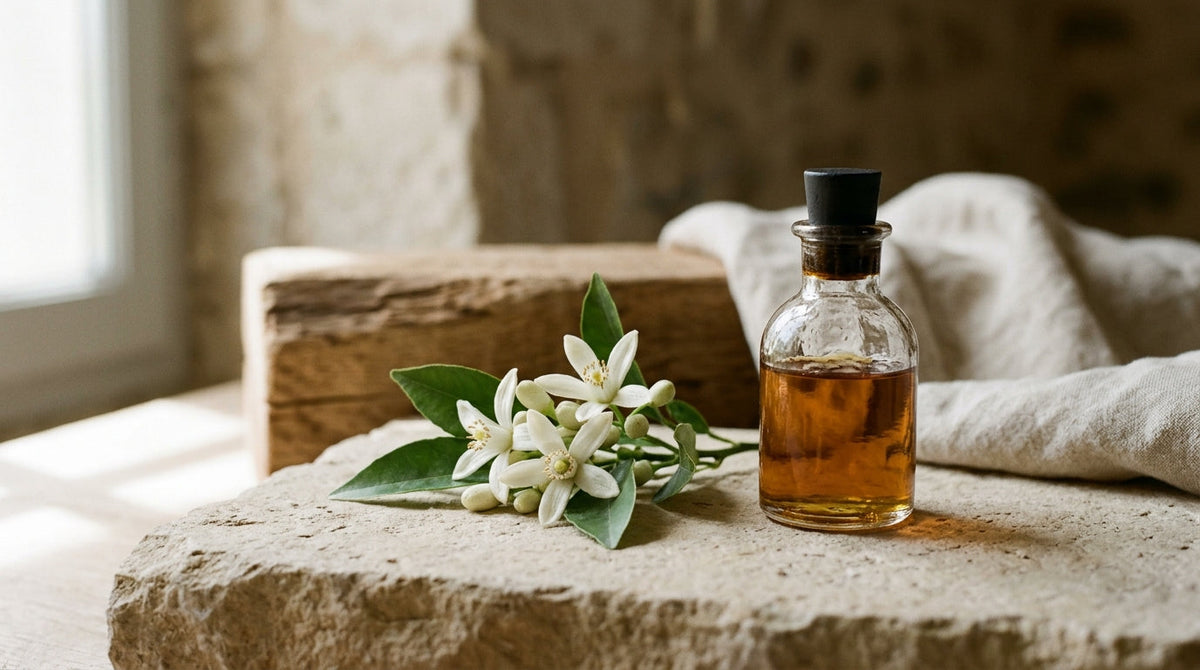
Neroli and orange blossom are not two different materials harvested from two different trees: they are two distinct extractions of the same flower, that of the bigarade tree (Citrus aurantium var. amara), the bitter orange. The fruit of this tree is not eaten, it is too sour; it is the flower that interests the perfumer, and depending on how it is processed, it yields two scents that have almost nothing in common.
One flower, two extraction processes
Neroli is the essential oil obtained by steam distillation of fresh bigarade flowers. The steam passes through the flowers and carries off the volatile compounds, then the mixture of water and essential oil separates as it cools: the essential oil floats on the surface, that is neroli; the remaining water, laden with soluble aromatic traces, is orange blossom water, used in cooking as well as in cosmetics.
Orange blossom absolute, on the other hand, is obtained by volatile solvent extraction, followed by an alcohol wash that isolates the odorous compounds first as a concrete, then as an absolute. This process, gentler than heat distillation, captures molecules that steam cannot carry: the result is a denser, more animalic scent, closer to the freshly picked flower.
Yield explains the price gap between the two. It takes about 1,000 kg of flowers to obtain 1 kg of neroli by distillation, a yield comparable to that of rose or jasmine. The absolute, produced in smaller quantities and by a more costly process, remains the rarer of the two.
Why the two scents do not resemble each other
Neroli carries a green, slightly bitter, almost metallic facet in the opening, inherited from the flower's most volatile molecules — linalool, linalyl acetate — which withstand distillation well. It is a fresh, lightly citrus scent, more reminiscent of citrus peel than of honey. It pairs naturally with lemony top notes: neroli is in fact often found in the opening, alongside a citrus fruit such as bergamot, in the classic structure of an eau de Cologne.
The absolute, for its part, retains heavier, more indolic molecules, which give a fleshier scent, almost animalic in places, close to that of jasmine or of orange blossom as you smell it leaning over the tree in bloom. It is this version that is found in floral compositions seeking substance rather than freshness.
At Odorare, this dual nature appears in very different compositions. Oranger Sirocco, by Les Indémodables, plays on a spicy floral register in which orange blossom keeps its fleshy texture without ever tipping into excess. Conversely, Sex and the Sea Neroli, signed Francesca Bianchi Perfumes, builds its citrus floral opening on the greenest and most saline facet of neroli, closer to citrus fruit than to a round flower.

Tunisia and Morocco: two benchmark terroirs
Growing the bigarade tree for neroli has historically been concentrated around the Mediterranean, and two countries are now recognised producers: Tunisia and Morocco.
In Tunisia, the Cap Bon region accounts for most of the production. The climate, hot and dry in summer, humid in winter, suits this tree, native to Asia but acclimatised to the Mediterranean for centuries — its introduction to Europe is dated to around the 11th century, via the Arab-Andalusian trade routes. Tunisian neroli is renowned for its clean freshness and its pronounced green facet.
In Morocco, cultivation is concentrated notably in the Marrakech and Souss regions, where the bigarade tree grows alongside other citrus trees. Moroccan neroli, often distilled on a smaller scale, has a slightly rounder, less tangy scent than its Tunisian counterpart, a nuance that perfumers seek depending on the effect they want in a composition.
In both countries, the harvest is done by hand, flower by flower, early in the morning before the heat dissipates the most volatile compounds — a constraint shared by all white flowers destined for fine perfumery, from jasmine to tuberose.

A material that shapes very different registers
Orange blossom, in both its forms, is not limited to a single type of composition. It runs through the most classic as well as the most singular registers of the niche catalogue.
Printemps Blanc, by Maison Mataha, pairs orange blossom with a citrus facet for a luminous floral result, conceived as a reminder of the season when citrus trees are in bloom. In a more structured register, Promise, signed Frédéric Malle, builds a woody floral accord in which orange blossom brings its roundness without dominating the composition.
A classic widely known to the general public, Eau d'Orange Verte by Hermès, long embodied this citrus-floral register carried by neroli and bitter orange peel. In that spirit, in the catalogue: Sirocco, by Christian Provenzano, which also pairs a floral opening with a crisp citrus facet.
How to tell which one you are smelling
Beyond the technical data sheet, a few simple markers make it possible to tell the two apart when trying them. Neroli evaporates faster; its green freshness dominates the first few minutes, then fades. Orange blossom absolute lasts longer on the skin, with a roundness that thickens slightly over time, a sign of the heavier molecules it contains. In a finished perfume, it is often a blend of the two, or one complemented by white notes such as jasmine or tuberose, that builds the final accord.
What exactly is orange blossom water?
It is the residual water from neroli distillation: it contains traces of water-soluble aromatic compounds, enough to scent lightly, but in far too small a quantity to make a lasting skin perfume. It is mainly used in cooking and cosmetics.
Why does neroli smell different from orange?
The orange, the fruit, and orange blossom have almost no odorous compounds in common. The flower is distilled for its own scent, very far from that of the peel or zest, which is citrus and comes from an entirely different part of the tree.
Do neroli and orange blossom cost the same?
No. The absolute, produced by solvent extraction and in smaller quantities, generally costs more per kilo than neroli essential oil obtained by distillation.
Can you smell the difference in a finished perfume?
Yes, with practice: neroli brings a green, fresh facet noticeable in the top notes, the absolute a fleshier floral roundness that lingers longer in the heart of the composition.
Is the bigarade tree the same as the orange tree whose fruit we eat?
No. The bigarade tree (Citrus aurantium var. amara) is a variety distinct from the sweet orange tree grown for its fruit. Its fruit is bitter and rarely eaten; it is its flower that interests perfumery.
Together, orange blossom and neroli show how a single plant can give rise to two quite distinct raw materials depending on the process chosen. Understanding this difference helps you read an olfactory pyramid better and spot which of the two facets dominates in a perfume. To explore other materials that shape niche perfumery, head to the pillar page The major raw materials.
Sources: IFRA (raw material data sheets), Osmothèque, Fragrantica (product pages cited), official websites of the houses cited.