
Eau de Cologne: The History of a 1709 Recipe
Eau de Cologne was not born in a luxurious Parisian laboratory, but in the back room of an Italian perfumer who had moved to Germany at the beginning of the 18thth century. What is known today as a hesperidic family — fresh, citrusy, light — has for three hundred years borne the name of the city where this water was developed: Cologne, in 1709.
Jean-Marie Farina, an Italian in Cologne
Giovanni Maria Farina was born in 1685 in Santa Maria Maggiore, a village in the Italian Piedmont. He joined Cologne in 1708 to partner with his uncle in the family business and Germanized his first name upon settling: Jean-Marie Farina. It was there, in 1709, that he developed a light alcoholic water, inspired, in his own words, by the scents of his native region “after the spring rain.” He christened it Eau Admirable, but it later took the name of the city where it was born: Eau de Cologne.
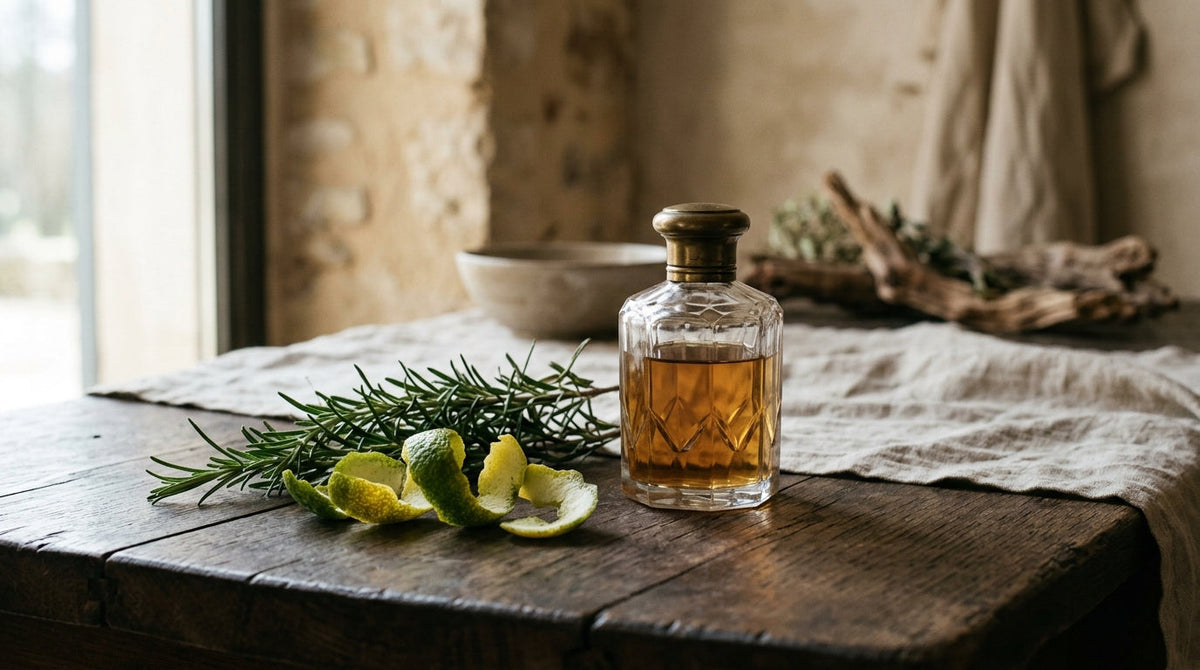
The formula can be summed up in a few words: wine alcohol, bergamot essence, lemon, orange blossom (neroli), and rosemary. Nothing rare, nothing expensive — that is precisely what makes it so effective: an immediate freshness, lightly concentrated, intended to be poured onto a handkerchief or diluted in rinse water rather than sprayed on the skin like an evening perfume.
A water conceived as much as a remedy as a perfume
In the 18thth century, the boundary between perfumery and pharmacy was porous. Farina's Eau Admirable was sold as both eau de toilette and tonic: it was drunk diluted in sweetened water, rubbed on the temples to relieve migraines, and used to soak cloths. This ambiguity between skincare and perfume shaped the perception of eau de Cologne for a long time: light, almost medicinal, far removed from the density of court perfumes. This lightness explains why the hesperidic family is still associated today with the idea of freshness rather than a powerful trail — a classification that can be found in the logic of current concentrations, from eau de toilette to extrait.
The Farina house enjoyed rapid success. Napoleon Bonaparte became a regular customer during his campaigns, establishing the product's reputation far beyond Cologne. The company founded by Giovanni Maria Farina still exists today at the same address and claims the oldest continuously produced perfume recipe.

Mülhens and the dispute over the name
The success of the formula attracted competition, and that is where the story becomes complicated. In 1792, a merchant named Wilhelm Mülhens also opened a perfumery in Cologne. His family claimed to have received the recipe from a monk as a wedding gift — a story that perfume historians today consider a marketing legend rather than an established fact. Mülhens marketed his own water under the name Farina, taking advantage of the popularity of the name already established in the city.
A legal and commercial conflict followed, lasting more than a century: several descendants and successors used the Farina surname, with or without a real family connection to Giovanni Maria. The Mülhens house eventually developed its own brand around a famous address, 4711 Glockengasse, which gave its name to the best-known eau de Cologne of the 19thth century. The two houses, Farina and Mülhens, still coexist today under distinct identities. This story of disputed authorship has never been definitively settled by historians: it remains, as is often the case with vintage perfume, a matter of competing sources rather than a single truth.
From the 1709 recipe to today's hesperidic family
The structure invented by Farina — citrus fruits in the top notes, a floral touch, and a very subtle base — became a classification in its own right in modern perfumery: the hesperidic family, named after the scientific name for citrus fruits (Hesperidae). The term is no longer reserved for the fresh waters of the 18thth century: today it describes any composition in which bergamot, lemon, or orange dominates the olfactory opening.
In the catalog, this lineage is clearly evident in contemporary creations that adopt the principle without copying the formula. Vibrato by Sospiro combines citrus fruits with a woody base, far from the original lightness but faithful to the classic hesperidic opening. Closer to Farina's original spirit, 005 Riviera Absolue by Bon Parfumeur plays on an aromatic freshness directly inherited from this family.
A widely known classic illustrates this evolution well: Eau Sauvage by Dior, a men's perfume created in 1966 around a hesperidic-chypre accord, helped popularize this citrus freshness in 20thth-century perfumery. In the same spirit, in the catalog: Azemour les Orangers by Parfum d'Empire, which combines citrus fruits with a comparable chypre structure.

Bergamot, the central ingredient of this family
If one ingredient summarizes the legacy of eau de Cologne, it is bergamot. This citrus fruit, grown mainly in Calabria in southern Italy, yields an essence that is both tart and slightly floral when its zest is cold-pressed, and is less pungent than lemon. It opened the Eau Admirable of 1709, and it still opens the majority of contemporary hesperidic compositions.
Two creations in the catalog illustrate very different treatments of this ingredient. Néroli & Bergamote de Denim by pH Fragrances combines bergamot with orange blossom, recreating Farina's original accord almost exactly. In contrast, Nice Bergamote Extrait by Essential Parfums pushes the ingredient toward a gourmand register, proving that the hesperidic family has largely expanded beyond its founding framework.
What distinguishes an eau de Cologne from a modern hesperidic perfume
Confusion is common: not every fresh, citrusy composition is an “eau de Cologne” in the technical sense. Historically, the term refers to a specific concentration — generally between 2 and 5% perfume oils diluted in alcohol, which explains its lightness and short longevity. A modern hesperidic perfume, on the other hand, can be formulated as eau de parfum or even extrait, with a much higher concentration while retaining the same olfactory opening profile. This distinction in concentration overlaps with the detailed distinction between eau de toilette, eau de parfum, and extrait — two logics, one historical and the other technical, that overlap without being confused.
Our selection for exploring the hesperidic family
For those who want to understand the legacy of 1709 by smelling it rather than reading about it, a few references in the catalog allow you to explore its variations: marine freshness with Artik Sea by Lorenzo Pazzaglia, the chypre version with Etruscan Water by Francesca Bianchi, or the floral interpretation with Aghla by Touch of Oud. Each starts from the same point — citrus fruits in the top notes — and moves toward a different olfactory territory.
Who really invented eau de Cologne?
The credit is given to Giovanni Maria Farina, an Italian perfumer who settled in Cologne and developed his formula in 1709. The Mülhens family claims a different origin, allegedly passed down by a monk, but this version is not confirmed by historians and remains disputed. Both houses still exist today, separately.
Why is it called “eau de Cologne”?
Because it was created and marketed in the city of Cologne, in Germany, by Jean-Marie Farina. The city's name remained attached to the product, and then to an entire olfactory family built on the same principle of hesperidic freshness.
What is the difference between an eau de Cologne and a hesperidic perfume?
Eau de Cologne historically refers to a specific concentration, generally light, around 2 to 5% oils. A modern hesperidic perfume shares the same olfactory family — dominated by citrus fruits — but can be formulated at much higher concentrations, as eau de parfum or extrait.
Why does eau de Cologne last less than a classic perfume?
Its historical composition relies on highly volatile citrus oils, such as bergamot or lemon, and on a low concentration of perfume ingredients. These two factors explain its shorter longevity, which was traditionally compensated for by more frequent applications.
Does the Farina house still exist today?
Yes. The company founded by Giovanni Maria Farina is still operating in Cologne at the same historic address and continues to claim the original 1709 recipe.
Key takeaway
Eau de Cologne was born from a specific, dated, and documented recipe: 1709, Giovanni Maria Farina, an accord of citrus fruits and white flowers designed for its lightness. Its success sparked a dispute over the name that has lasted for more than two centuries, with no definitive truth between the Farina and Mülhens houses. Three centuries later, this simple formula gave birth to an entire olfactory family that the Odorare catalog offers in a wide variety of forms. To continue this historical exploration, we turn to the birth of modern perfumery, when Guerlain, Coty, and Chanel in turn transformed the perfume industry.