
Ancient Egyptian perfumery: kyphi and unguents
Ancient Egypt did not know the alembic: distillation would only appear there centuries later. To capture the scent of flowers and resins, the Egyptians used a slower but equally effective technique, cold enfleurage, and a long cooking of fats and resins that would give rise to kyphi, the most complex preparation of Mediterranean antiquity.
Cold enfleurage, the basic technique of ancient Egypt
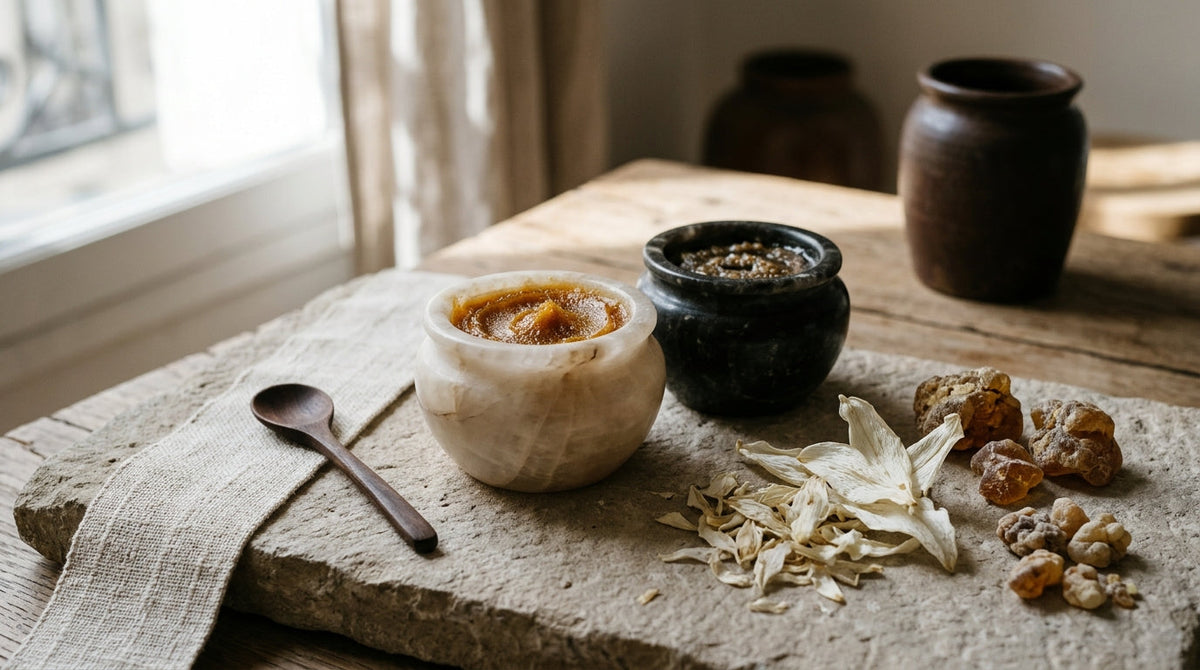
The principle is simple to state and long to carry out: fresh flower petals are laid on a layer of animal fat, most often beef or goose fat, spread over a support. The fat absorbs the odorous compounds of the petals within a few hours. The wilted petals are removed, fresh ones are laid down, and the operation is repeated dozens of times until the fat is completely saturated. The result is a perfumed unguent, solid at room temperature, kept in calcite or alabaster jars — a stone chosen for its ability to maintain a stable temperature and limit evaporation.
This method made it possible to work with lily, jasmine or henna flower, flowers too fragile to withstand heat. The Egyptians also mastered hot maceration, which was faster: the raw materials were immersed in an oil or fat heated to a low temperature, which accelerated the diffusion of the odorous compounds but altered some of the most delicate notes.
Kyphi, a preparation with many ingredients
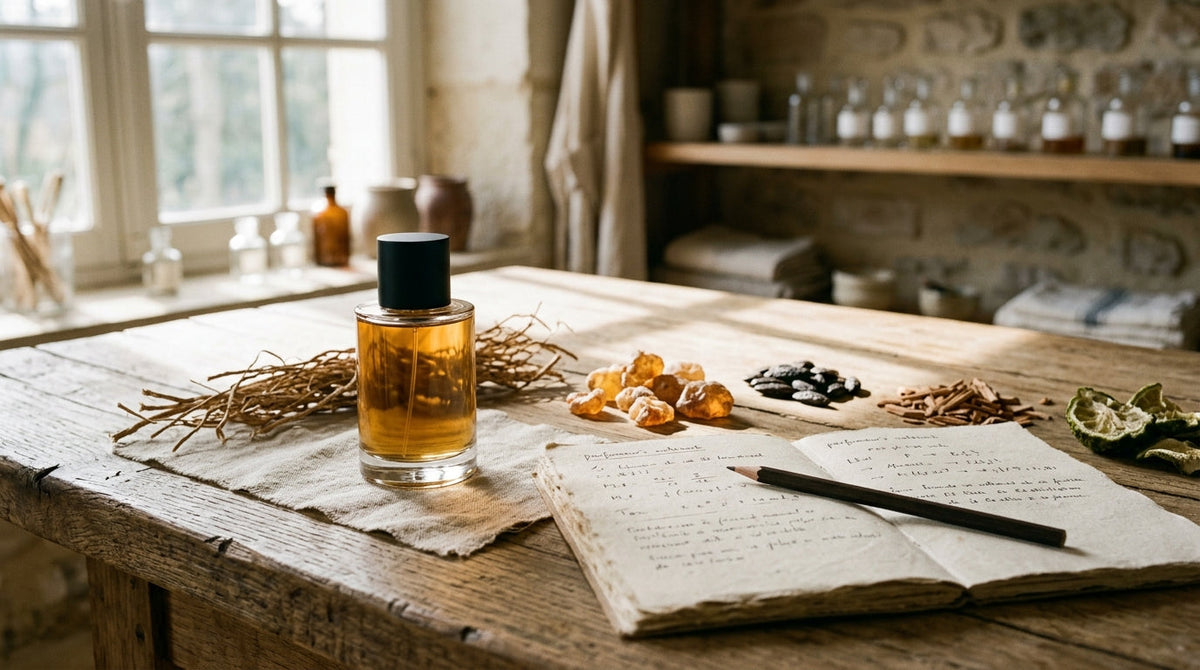
Kyphi is the composition most often cited in ancient texts, notably by the Greek historian Plutarch, who details how it was made in his treatise on Isis and Osiris. Its recipe combines several resins, dried fruits and aromatic plants, in proportions that vary according to the versions that have come down to us: resins (myrrh, frankincense), raisins, honey, wine, juniper, cinnamon, sweet flag (calamus), and other local or imported aromatic plants. The preparation follows a precise order: the dried plants are first ground and sifted, then mixed with the wine and honey, and finally cooked over a low heat with the resins until a compact paste is obtained, which was shaped into small balls or pastilles.
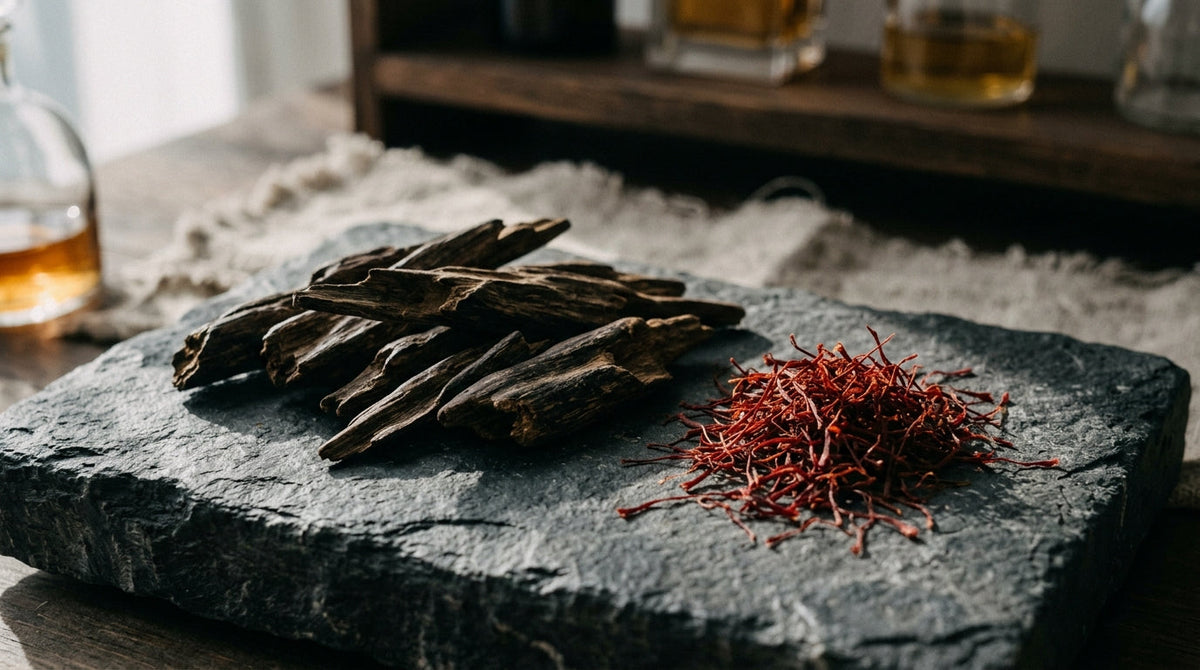
Kyphi was not worn on the skin like a perfume in the modern sense. It was burned to diffuse its scent into the air, a fumigation practice close to what one would do today with incense. In this spirit of slow, resinous combustion, the catalogue offers references such as Oud Bakhoor, an agarwood incense with a woody, smoky register that gives a concrete idea of what the combustion of a dense resinous material can produce.

Raw materials: what Egypt imported
Ancient Egypt produced certain aromatic plants locally — lily, henna, reed — but depended almost entirely on imports for its most precious resins. Myrrh and frankincense came from the Arabian Peninsula and from the region that Egyptian texts call Punt, probably located on the coasts of today's Horn of Africa. These expeditions, organised by boat along the Red Sea, are documented by the reliefs of Queen Hatshepsut's temple at Deir el-Bahari, which show the loading of resins, whole trees in pots and precious woods.
Cinnamon and cassia came from even longer trade routes, reaching as far as South Asia via Arab intermediaries, which explains their high price and their reservation for the most prestigious uses. This dependence on imported materials is no ancient exception: it still structures niche perfumery today, where oud, sandalwood or saffron travel thousands of kilometres before ending up in a bottle. A perfume such as Luz Infinita, signed Ramón Béjar, in a woody, amber register, illustrates the same logic of a rare material brought from afar to build a dense composition.

Everyday unguents and funerary uses
Beyond kyphi, reserved for great occasions, the Egyptians used simpler unguents in daily life, against the dryness of the climate and to mask body odours in a society without soap as we know it. These preparations combined fat, castor or moringa oil, and a flower or a resin depending on each person's means.
In the funerary context, embalmers used resins and aromatic oils for their drying and preservative properties, a technical use documented by chemical analyses carried out on mummies and their wrappings: traces of pistacia resin, cedar and bitumen have been found in them. These substances slowed decomposition by limiting bacterial growth, a primarily practical function that the technical texts of the time describe precisely, without any need to invoke anything other than an empirical chemistry that was already sophisticated for its time.
What ancient perfumery passed on
The disappearance of pharaonic Egypt did not take its techniques with it. Enfleurage was passed on to Greece and then Rome, where it coexisted with pressing methods. It would take the Arab-Muslim world of the Middle Ages, and scholars such as Avicenna, to see the emergence of alembic distillation, which would lastingly change the way perfume is made — a subject we explore in detail in our article on rose distillation in the Middle Ages. Between these two moments, centuries of Egyptian practice established essential gestures: the fine grinding of resins, controlled cooking, the reasoned blending of several materials to obtain a scent that remains stable over time.
An echo of this ancient alchemy can be found in contemporary amber compositions, which also combine resins, sweet materials and warm notes to build a scent that lasts. The Amber Fragrances collection in the Odorare catalogue extends, in its own way, the search for a dense and persistent sillage that the artisans of the Nile were already pursuing.
Our selection to take this reading further
For those who wish to smell what these resinous, smoky textures evoke, two complementary paths: direct combustion, with the Incense collection, which takes up the very principle of kyphi burned as a fumigation; and amber worn on the skin, with compositions such as Glow by AKRO, an amber floral extrait that builds a warmth comparable to the one sought by the ancient unguents, without reproducing their formula.
Frequently asked questions
Did the Egyptians know distillation?
No. No archaeological or textual evidence shows the use of an alembic in ancient Egypt. Their techniques relied on enfleurage, maceration and the cooking of fats, not on the vaporisation and condensation that characterise distillation.
What exactly is kyphi?
A cooked blend of resins, dried fruits, honey, wine and aromatic plants, shaped into pastilles intended to be burned. Its exact composition varies according to the sources that have come down to us, but how it was made is described by the Greek historian Plutarch in his treatise on Isis and Osiris.
Where did Egyptian raw materials come from?
Resins such as myrrh and frankincense were imported by boat from the Arabian Peninsula and the region called Punt, along the Red Sea. Cinnamon came from even more distant trade routes, via Arab intermediaries.
Why were oils and resins used in embalming?
For their drying and antibacterial properties, which slowed the decomposition of the body. Chemical analyses carried out on mummies confirm the presence of pistacia resin, cedar and bitumen in embalming fabrics.
Can perfumes made by enfleurage still be found today?
Yes, though it is rare: the technique is long and costly. A few houses still use it for fragile flowers such as tuberose or jasmine, alongside more modern extraction methods.
Ancient Egypt left no formula intact, but it established a method: grind, blend, cook, preserve. This technical rigour, more than the myth that often surrounds it, explains why its unguents have come down through three thousand years of history. The next stop in this series takes us further north, to a tanners' village that became the world capital of perfume.
Sources: Plutarch, On Isis and Osiris · reliefs of Queen Hatshepsut's temple at Deir el-Bahari · published chemical analyses of Egyptian embalming resins · Osmothèque.