
Oud and saffron: an accord born between the Gulf and Asia
Oud and saffron did not meet by chance in a laboratory: they have crossed paths for centuries on the trade routes linking South Asia to the Arabian-Persian Gulf. The resinous wood from Cambodia, Laos or Assam reached the ports of Oman and the Emirates at the same time as spices from the Indian subcontinent, with saffron from Kashmir or Iran at the forefront. The oud-saffron accord is therefore not a recent invention of niche perfumery: it is the olfactory memory of a trade.
Why these two materials answer each other
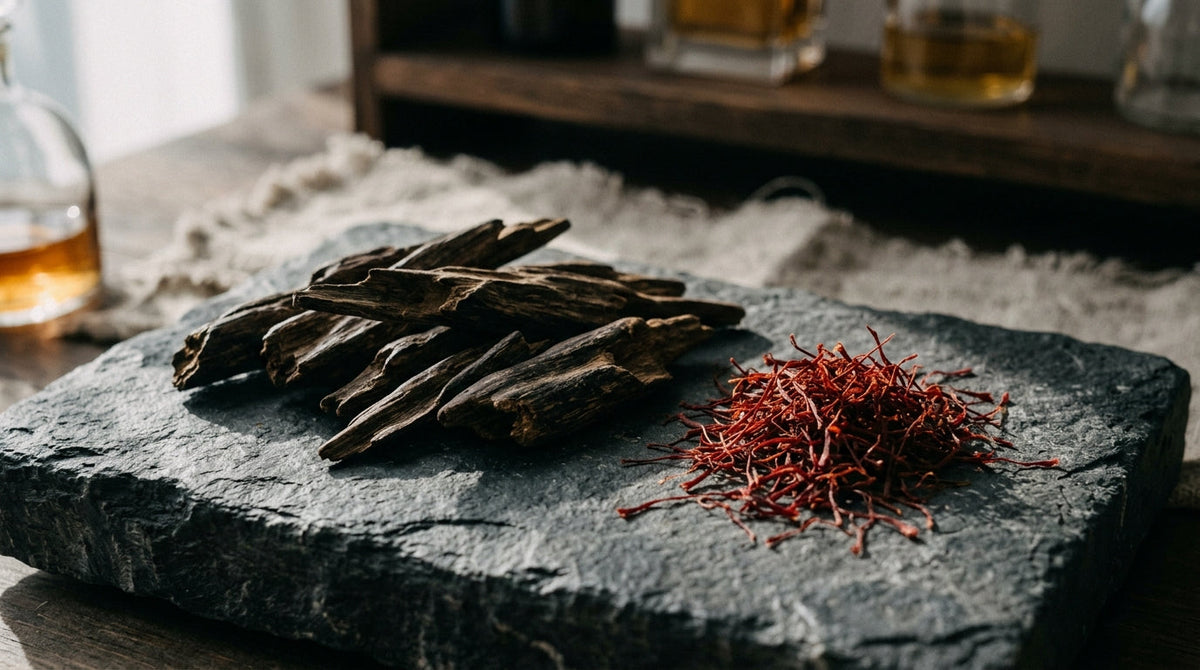
Oud, once distilled or extracted, gives an animalic, earthy, sometimes slightly smoky material, with a depth that settles slowly on the skin. Saffron, for its part, is a dry, metallic spice, with a natural leathery facet and an almost medicinal edge before turning to warm hay. Placed side by side, the two share a surprising kinship: both have a leathery side, which explains why they layer without contradicting each other rather than complementing each other through opposition.
The contrast, for its part, plays out in texture. Saffron arrives as a heart note, dry and almost crisp, while oud occupies the base with a dense material, almost viscous by comparison. It is this interplay between a spice that stings and a wood that envelops that gives the accord its relief: you first smell the dryness of saffron, then the roundness of oud takes over as the perfume dries down on the skin.

A trade route, not a laboratory accord
Before becoming a perfumer's composition, oud and saffron travelled together in the holds of the dhows linking the ports of the Gulf to those of India and Southeast Asia. Agarwood, harvested in the forests of Cambodia or Assam, and saffron, grown on the high plateaus of Kashmir or Iranian Khorasan, came together in the same markets of Oman and the Emirates, where they were already used together in the bakhoor blends burned during receptions. Modern Gulf perfumery, which largely shaped the image of oud in the West, inherited this habit of pairing the two materials rather than inventing it.
In the catalogue, this lineage can be read directly in compositions such as Jild, by Jouri Perfumes, which builds a spicy woody accord where oud serves as the foundation for dry spices close to the saffron register. A similar logic can be found in Utaki Sacré, by Orens, where spice and wood layer without one erasing the other.
Recognising the accord in a perfume
A well-built oud-saffron accord can be recognised by a precise chronology. At the top, saffron announces itself with a dry, slightly leathery facet, sometimes accompanied by a smoky edge if the perfumer has chosen a distilled oud rather than a synthetic one. In the heart, the spice begins to warm up, taking on notes of hay and dry honey. In the base, oud takes over completely: it provides the longevity and the substance, while the memory of saffron lingers in transparency, almost like a spice left to infuse in wood.
This pattern can be found in Himalayan Spell, by Obvious, where the spicy woody construction follows exactly this logic of a dry top and a deep woody base. The same principle of contrast between a lively spice and a dense wood also structures Oud Assam, by Rania J, which works a spicy woody material named directly after one of the most renowned oud-producing regions.

An accord not to be confused with other oud pairings
Oud pairs with many materials, and it is useful not to confuse the registers. The oud-rose accord, for example, plays on a contrast between floral freshness and woody density, a very different territory from the one explored here — we have covered it in a dedicated article. The oud-saffron accord, on the other hand, stays in an entirely dry and spicy register, without the green or powdery facet that a rose brings. It is a distinction that matters when choosing a perfume: a lover of warm, dry woody scents will turn to the spicy accord, while a lover of floral woody scents will prefer the other direction.
A useful reference point for placing this register: Yara, by Lattafa, popularised a very sweet and accessible saffron-oud accord among the general public. In a drier, less gourmand spirit, the catalogue offers Sidra Wood, by Al Jazeera Perfumes, which keeps the leathery woody dimension without leaning on sugar.
The two ways to dose saffron
In perfumery, saffron is used in two main forms: the absolute, obtained by solvent extraction of the dried stigmas, costly and faithful to the real spice, and synthetic reconstructions that render its leathery facet at a lower cost. Both approaches have their place: the first gives a more complex and changing material, the second allows a franker dosage that is more stable over time. In an oud-saffron accord, the choice between the two directly influences the character of the perfume — more animalic and deep with the natural absolute, cleaner and more linear with the synthetic version.
What to remember when choosing
If you are looking for a perfume that develops the oud-saffron accord in its driest and woodiest form, favour a composition described as spicy woody rather than gourmand oriental: sugar often masks the contrast of textures that makes this accord interesting. Conversely, if you are discovering oud for the first time, a version where saffron stays discreet at the top softens the introduction without betraying the structure.
Does saffron enhance the longevity of oud?
Not directly: it is oud that carries the longevity, thanks to its molecular density. Saffron acts mainly in the top and heart, where it colours the initial perception of the perfume before gradually fading behind the wood.
Does saffron really smell like the kitchen spice?
At the beginning of evaporation, yes: you recognise a dry, slightly metallic facet close to the cooking spice. But in perfumery, saffron then evolves towards notes of warm hay and leather, quite far from its culinary use.
Can you wear this accord on sensitive skin?
Yes, provided you choose a suitable concentration. An extrait de parfum keeps the accord in its densest version; an eau de parfum makes it airier and easier to wear every day.
Why is oud often associated with the Gulf rather than with Asia, where it actually grows?
Because the Gulf was the great market and the great consumer of oud long before the West, turning an Asian raw material into a cultural symbol specific to the region, notably through bakhoor and traditional perfumes.
Is the oud-saffron accord better suited to winter?
It is indeed a warm, dense accord that expresses itself particularly well in cold weather, even if some compositions lighter in saffron remain wearable all year round.
The oud-saffron accord tells a story of trade as much as an olfactory story: two precious materials, born thousands of kilometres apart, brought together by the routes of the Gulf. To take this exploration further, our article on saffron in perfumery details its harvest and uses more precisely, and the complete guide to oud gathers all the keys to understanding this material.
Sources: official Jouri Perfumes website, official Rania J website, Fragrantica, Osmothèque.