
Saffron in perfumery: leather, honey and spice
The scent of saffron is intriguing because it resembles no other spice: leathery, slightly medicinal, and gently honeyed all at once. This scent comes from a specific molecule, safranal, produced in minute quantities by the crocus flower. It is so rare and so costly to extract that perfumery most often reconstitutes it synthetically—a common practice, not a shameful shortcut.
Where does the scent of saffron come from?
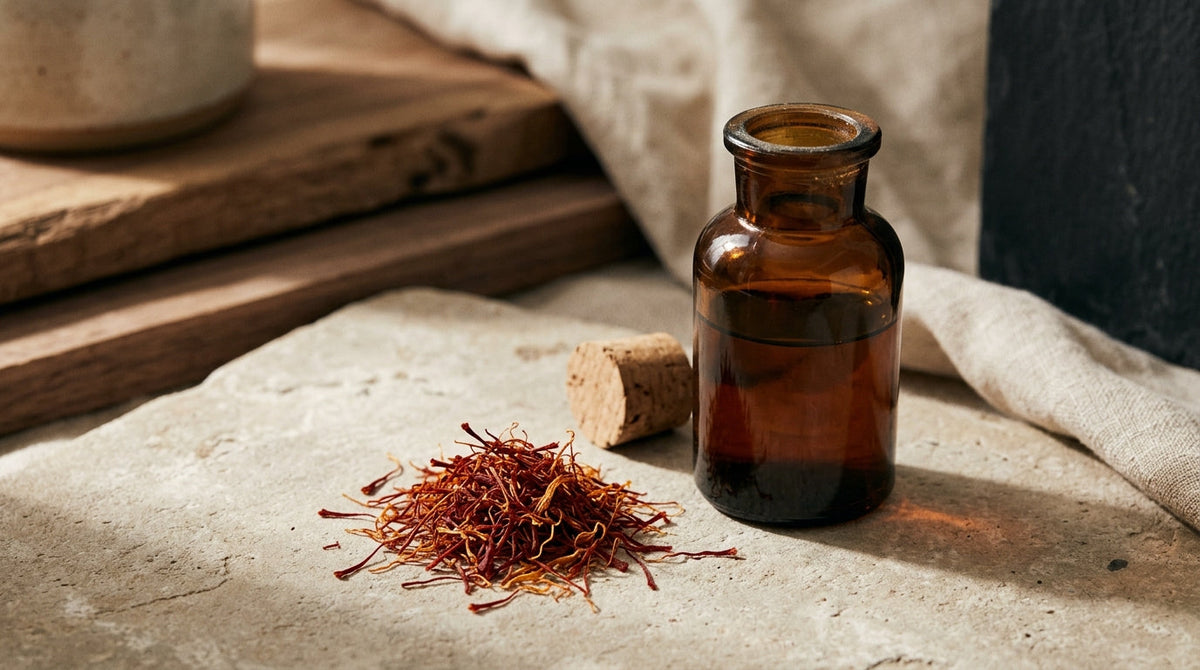
Saffron comes from the stigmas of the Crocus sativus, picked one by one by hand from a flower that opens for only a few days a year. It takes about 150,000 flowers to obtain a single kilo of dried saffron, making it one of the most expensive spices in the world—long before cooking, it is this price that explains its rarity in natural form in perfumery.
The characteristic scent comes from safranal, a volatile compound that appears during the drying of the stigmas, when another molecule (picrocrocin) transforms under the effect of heat. It is safranal that gives this note its dry, slightly bitter, and smoky character, very different from the spiciness one expects from a cooking spice.
Why does saffron evoke leather?
This is the most surprising facet of this material: used in perfumery, saffron easily leans toward the scent of tanned leather, dry and slightly animalic. This kinship explains why it is so often found associated with smoky woods, incense, or genuine leather in oriental compositions. The spice then serves as a bridge between a warm top note and a darker base.
In Marhaban by Maison Eau de Couture, this tension between the aromatic and the woody hints at how a spice can turn toward a leathery register without any animal leather actually being present in the formula. The scent of saffron often works this way: it suggests a material that it is not.
To explore this kinship between spice and tanned skin further, our article on leather in perfumery details how perfumers reconstitute this scent through other means—a subject that largely overlaps with that of saffron.

A honeyed and gourmand facet
Another peculiarity of saffron: when associated with sweet materials, it takes on an almost candied turn, close to honey or caramel. This is the side often chosen by contemporary gourmand compositions, where the spice is no longer an exotic marker but a warmth at the back of the palate.
Coco Za'faran by Indices Parfums (Coco Za'faran) perfectly illustrates this turn: the very name of the composition claims saffron—za'faran in Arabic—associated with a milky and gourmand material. In a similar register, Halwa Kiss by OJAR builds a spicy gourmand where the spice plays the same role of a binder between the sweet and the warm.
This dual nature—leathery on one hand, honeyed on the other—explains why saffron is one of the few raw materials capable of crossing almost all olfactory families without ever completely blending into them.
Natural saffron, safranal, and Safraleine: what is hidden in the bottle
📌 It must be said simply: the vast majority of saffron notes in perfumery do not come from stigmas infused in alcohol, but from molecules reconstituted in the laboratory. Synthetic safranal reproduces the dry and smoky note of the natural spice. Safraleine, a molecule patented by Firmenich, on the other hand, brings a more leathery and powdery facet, used to extend the longevity of this usually fleeting note.
This is not a compromise by default: it is a solution that allows for a stable saffron scent, precisely dosable, and accessible at a cost that makes the material truly usable in a formula. Natural saffron exists in niche perfumery, but in minute quantities, often as a reinforcement of an accord largely built around these synthetic molecules.

How to spot saffron in a composition
In the top, saffron reveals itself with a dry, slightly peppery note, sometimes close to raw leather. In the heart, it softens when in contact with flowers or sweet spices like cinnamon or cardamom. In the base, it leans toward leathery or honeyed depending on what surrounds it—woods, amber, vanilla.
A classic of the genre, Sahara Noir by Tom Ford, popularized this use of saffron associated with incense and wood in a dense oriental register. In this spirit, in the catalog: Jardins de Misfah by Une Nuit Nomade, which builds an oriental floral facet where the spice plays a similar binding role.
To better situate this material within the overall range of spices in perfumery, the Spicy Perfumes collection brings together compositions built around this same accord logic, while the Saffron Perfumes collection specifically groups references where this note dominates.
Frequently Asked Questions
Is the saffron used in perfumery the same as that used in cooking?
Chemically, the scent comes from the same molecule, safranal, present in the dried stigmas. But in perfumery, this scent is almost always reconstituted synthetically rather than extracted from the spice itself, for reasons of cost and stability.
Why does saffron sometimes smell like leather?
Safranal has a dry and slightly animalic facet that recalls tanned leather. Perfumers exploit this kinship to build leathery accords without using any real animal material.
Is natural saffron used in niche perfumery?
Yes, but in very small quantities, as a reinforcement of an accord largely built around synthetic molecules like safranal or Safraleine, which carry the bulk of the perceived scent.
What materials does saffron pair best with?
It works particularly well with leather, smoky woods, incense, rose, and gourmand materials like honey or vanilla, depending on whether a dry or candied register is sought.
Does saffron last long on the skin?
On its own, natural safranal is rather fleeting. This is why perfumers use molecules like Safraleine, designed to extend the longevity of this note throughout the perfume.
What to remember
Saffron owes its unique scent to safranal, a rare molecule that perfumery today recreates synthetically to guarantee its accuracy and stability. This spice naturally leans toward leather or honey depending on the materials that accompany it, making it a discreet pivot in many oriental and gourmand compositions. To continue this exploration of the great materials of perfumery, head to our Great Materials page, or for an equally ancient accord, the Oud and rose article.
Sources: Firmenich (Safraleine documentation), Fragrantica (sheets of the perfumes mentioned), FAO (production and cultivation of Crocus sativus), Osmothèque.