
Bakhoor: How to Burn It at Home
The bakhoor is a piece of agarwood infused with oils, resins, and sometimes musk or sandalwood, which is heated so that it releases its fragrant smoke. Unlike oud perfume, which is worn on the skin, bakhoor is burned: it scents a room, a fabric, an interior. Two methods exist for using it at home — charcoal, which requires a little practice, and the electric burner, which is easier to regulate — and this article details both, with the accompanying ventilation precautions.
What exactly is bakhoor
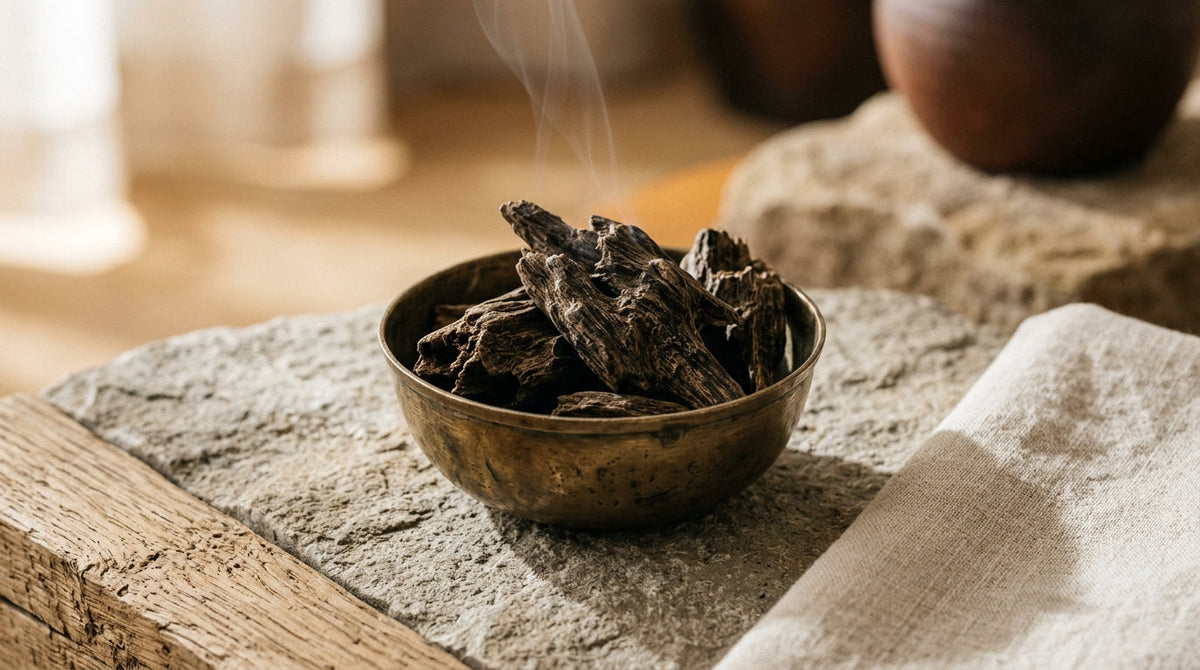
The word bakhoor refers to both the material and the everyday object in several regions of the Gulf and the Middle East: chips of agarwood (the same wood that produces liquid oud) soaked in a mixture of aromatic essences, then dried. Once heated, these chips release a dense, woody smoke, sometimes resinous or slightly sweet depending on the essences used. The Odorare catalog offers several variations of this material: the Luban Bakhoor, with a resinous woody profile, the Anbar Bakhoor, more ambery, and the Oud Bakhoor, with a distinctly smoky character. These three references allow you to compare, in a single gesture, three different facets of burned agarwood.
Bakhoor stands out from incense sticks or cones for one simple reason: it does not contain an integrated combustible support. An external heat source is therefore required — charcoal or an electric heating element — to melt it and release its fragrance. This is the step that differentiates the two methods presented below.
The charcoal method: the most traditional
Special incense charcoal (round, slow-burning, sold in discs) is the most widespread method in the countries of bakhoor's origin. The principle: you light the charcoal until it glows evenly, place it in a heat-resistant container — the mabkhara, the traditional incense burner, generally made of metal or ceramic, with a base of sand or ash that insulates the heat — then place one or two pieces of bakhoor directly on the ember.
- Lighting: hold the charcoal with tongs, light it with a flame until it crackles and turns grey on the surface, then let it rest for a few minutes before placing it in the mabkhara.
- Dosage: one piece of bakhoor is enough for a medium-sized room. The smoke is dense from the first few seconds: there is no need to add more.
- Duration: a charcoal ember diffuses for 20 to 40 minutes depending on its size. You can replace the piece of bakhoor without changing the charcoal as long as it remains hot.

The electric method: easier to master
The electric burner replaces charcoal with a heating element that heats at a constant temperature, without flame or ember. It is the method best suited for regular use at home: no combustion smoke, a more gradual dosage, and the possibility of stopping the diffusion at any time. The Subitism 2.0 works on this principle: you place the piece of bakhoor on the heated plate, set the intensity, and the material releases its fragrance through simple heat, without ever completely burning out. The Subitism 3.0 uses the same operation in a box presentation, designed for daily use.
With an electric burner, the rule is the opposite of that of charcoal: you start at low intensity, increase gradually until you feel the desired diffusion. The material lasts longer than with charcoal, sometimes an hour or more, because it does not burn, it heats up.
Ventilation and safety: the basics, without excess
Burning bakhoor produces smoke, whether it is charcoal or, to a lesser extent, an electric burner. A few simple precautions are enough to enjoy it safely:
- Ventilate the room during and after diffusion — a slightly open window is enough, no need to leave it wide open continuously.
- Place the container on a stable and non-flammable surface, away from curtains, papers, or fabrics.
- Never leave a lit charcoal unattended, and let it cool down completely before throwing it away.
- Limit the duration of diffusion in a continuously occupied room — about twenty minutes, renewable, is more than enough to scent an interior.
These are the same common-sense rules as for any domestic combustion: nothing alarming, just attention.

What to smell first: compare the profiles
For a first try, it is useful to compare two bakhoors with distinct profiles rather than buying one at random. The Luban Bakhoor gives a woody and resinous smoke, close to what is spontaneously associated with raw agarwood. The Oud Bakhoor, on the other hand, pushes the smoky trait further, with an intensity that marks an interior more. This difference recalls that found in fine perfumery between a discreet oud and a frankly assertive oud, a subject detailed in our selection of the best oud perfumes in the catalog.
Bakhoor and bottled oud share the same raw material but not the same use: one scents the air, the other the skin. To understand how agarwood becomes liquid oud, our article How is oud extracted? From the tree to the bottle details the distillation processes that separate the two uses.
Frequently asked questions
Can you burn bakhoor every day?
Yes, provided you ventilate the room regularly and do not leave it continuously filled with smoke. A daily diffusion of 15 to 20 minutes, with a slightly open window, is a common and moderate practice.
Do you need special charcoal or will any charcoal do?
You need charcoal intended for incense, slow-burning and without fast-burning flammable additives. Classic barbecue charcoal burns too quickly and gives off an odor that covers that of the bakhoor.
Does the electric burner damage the bakhoor?
No: the gentle heat of the burner melts the essences without carbonizing the wood, unlike charcoal which eventually consumes it. This is precisely what allows for a longer and more regular diffusion.
What quantity of bakhoor to use each time?
A single piece, weighing a few grams, is enough for a room of 15 to 20 m². The smoke diffuses quickly: it is better to start small and renew if necessary.
Can you use bakhoor to scent a garment or fabric?
Yes, it is a traditional use: you pass the fabric through the smoke from a good distance, without direct contact with the heat source, so that it absorbs it without burning.
What to remember
Bakhoor is burned on charcoal for a quick and intense diffusion, or on an electric burner for a simpler and longer use. In both cases, one piece is enough, minimal ventilation is required, and the material remains the same: agarwood infused with essences, a direct cousin of the oud that we wear as a perfume. To go further on this material and its uses, our pillar page Oud brings together all our articles on the subject.
Sources: Oman Luxury (product sheets and manufacturing descriptions), Fragrantica (bakhoor and oud glossary), Osmothèque (documentation on agarwood and its traditional uses).