
How is oud extracted? From tree to bottle
Extracting oud is not like picking a flower or incising resin: it means distilling diseased wood. The process begins long before fire and water, as soon as a tree of the Aquilaria or Gyrinops genus shows signs of a fungal infection that has blackened its heartwood. What follows is a process of sorting, cutting, and patience, far removed from the image of a mysterious extract that is simply collected.
Locating and harvesting the infected wood
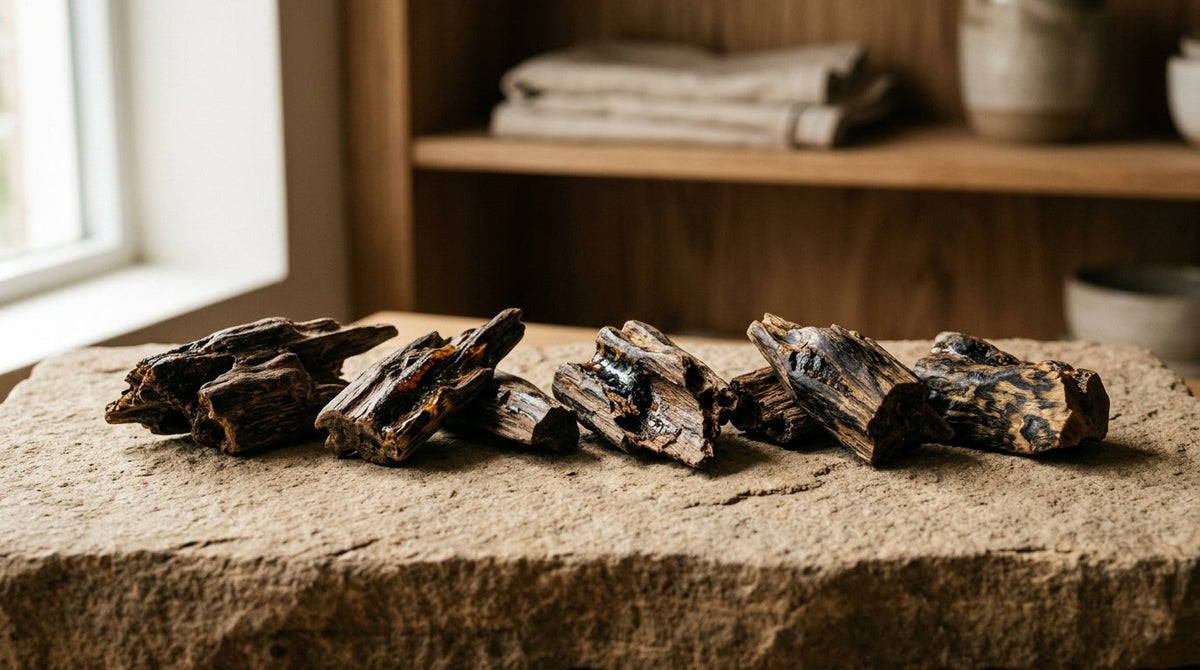
A healthy tree does not produce oud. The fragrant resin only appears when the wood is attacked by a fungus, most often of the Phialophora or Fusarium genus, after a wound in the bark. The tree reacts by secreting a dark, dense substance to block the infection: this impregnated area is what is called agarwood, or oud.
Harvesters probe the trunk with a machete or auger to locate the dark pockets, which are often invisible from the outside. A tree can take between fifteen and twenty years to develop an infection extensive enough to be commercially viable, which partly explains why the material remains rare. Once the infected areas are identified, the wood is cut into blocks and separated from the healthy sapwood, which has no olfactory value.
Sorting and chipping
The harvested wood is sorted by density and color: the darker and heavier it is, the higher the concentration of fragrant resin. The best pieces, dense enough to sink in water, are sometimes kept whole to be burned directly as bakhoor, an incense made of chips used in homes across the Gulf and Southeast Asia. The rest is intended for distillation.
For distillation, the wood is reduced to chips, sometimes ground finer depending on the workshop. This step determines the yield: the greater the surface area exposed to water, the more effective the extraction of aromatic compounds will be during cooking.

Soaking, a lengthy preparatory step
Before any distillation, the chips are soaked in water, sometimes for several days or even weeks depending on the methods. This soaking softens the wood structure and facilitates the release of volatile compounds during the subsequent cooking. Some workshops allow the mixture to ferment slightly, which alters the final olfactory profile of the oil obtained.
The duration and temperature of this soaking vary from one region to another and from one workshop to another: this is one of the parameters that distinguish Cambodian oud from Indian or Laotian oud, long before the distillation itself.
Hydrodistillation, the heart of the process
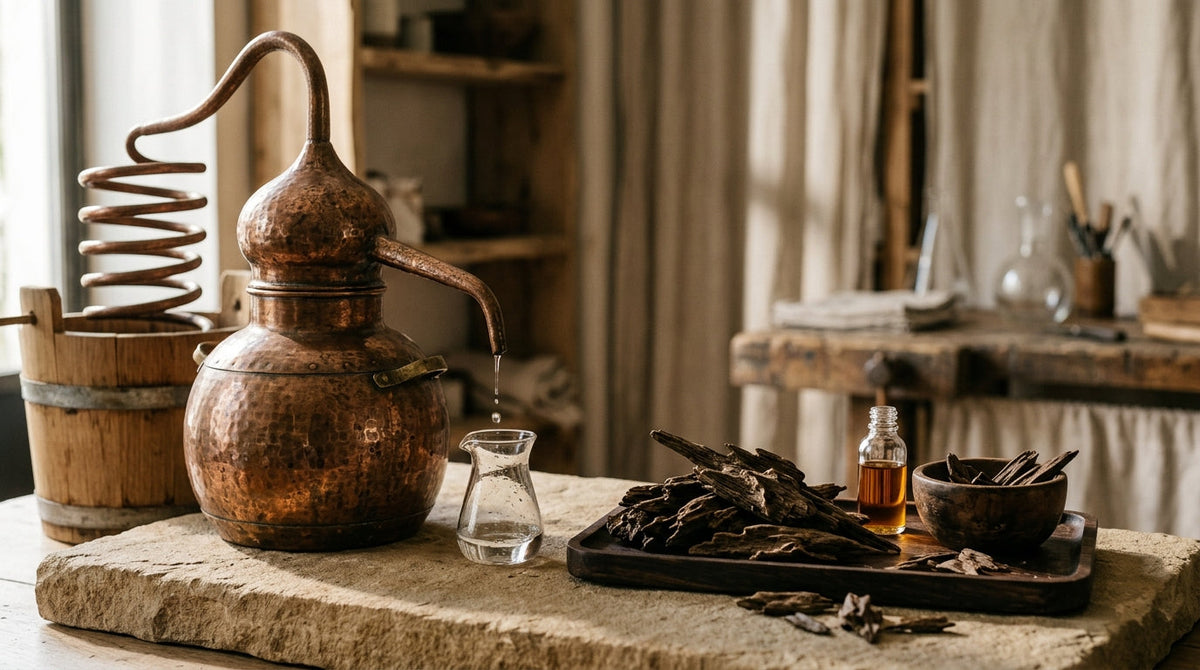
The soaked chips are placed in a still with water, then brought to a boil. This is the principle of hydrodistillation: the water vapor carries with it the volatile aromatic compounds of the wood. This laden vapor then passes through a coil cooled with cold water, where it condenses and returns to a liquid state.
Oud distillation generally takes between three days and several weeks, much longer than a lavender or rose distillation, which takes only hours. This slowness is explained by the density of the wood and the need to recycle the distillation water several times—the same batch of chips can be re-distilled up to five or six times to extract all its aromatic material.
Decantation: separating the oil from the water
As it leaves the still, the condensed liquid naturally separates into two phases. The oud oil, being lighter, rises to the surface of the floral water on which it floats. This decantation phase can take several days: the oil is gradually collected from the surface using a pipette or skimming system.
The oil obtained is called deg or dhan depending on the producing regions, a term that refers to raw oud oil before any refining. The yield is extremely low: on average, it takes between 30 and 70 grams of oil for about 20 kilos of quality wood, which places the price of the raw material far above that of most perfumery essences.

What happens to the oil after extraction
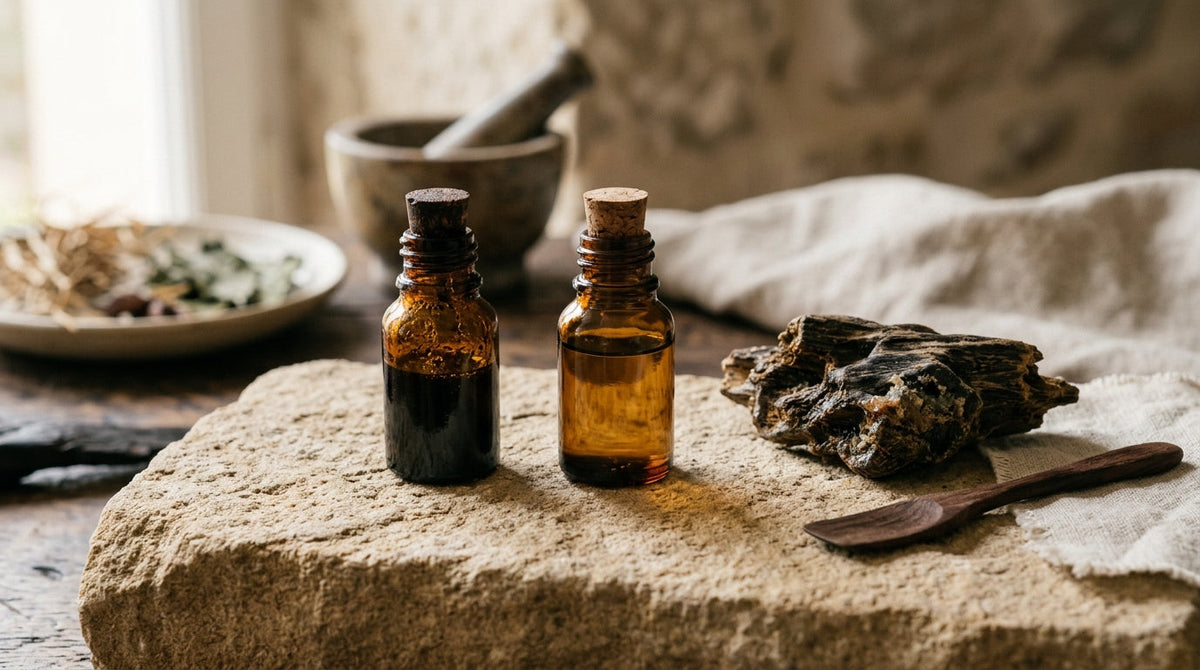
Once collected, oud oil can be used as is, applied directly to the skin according to traditional Middle Eastern practices, or diluted in alcohol to be incorporated into a perfume. It can also be aged for several months or even years in airtight containers: this aging softens certain fermented notes and rounds out the olfactory profile, somewhat like a wine left to mature in a cellar.
The oils obtained vary enormously from one batch to another, even when they come from the same tree: this is what makes each oud distillation unique, and explains why the houses that work with this material emphasize the origin and expertise of the workshop rather than a fixed formula. Our collection of oud perfumes brings together compositions where this oil is used in very different dosages, from a subtle base note to an unapologetic overdose. For those who prefer raw wood to oil diluted in a perfume, the bakhoor collection offers chips intended for direct combustion, in the tradition from which they come.
To experience this material in its different forms, you can compare the oil diluted in a woody floral composition such as Oud Aquilaria with raw wood intended for combustion, such as Oud Bakhoor, which comes from the same harvesting and sorting process described above. The woody, leathery elixir Oud Suprême in turn illustrates how an aged deg can be incorporated into a more structured composition.
Frequently Asked Questions
How long does oud distillation take?
Between three days and several weeks depending on the workshop, the quality of the wood, and the number of re-distillation cycles applied to the same batch of chips. It takes much longer than the distillation of flowers or citrus fruits.
Why is the yield of oud oil so low?
Because only a small portion of the wood, the area infected by the fungus, contains the sought-after aromatic compounds. From 20 kilos of quality wood, on average, 30 to 70 grams of oil are obtained.
What is deg or dhan?
These are two regional names for raw oud oil, collected directly after hydrodistillation and decantation, before any subsequent refining or dilution.
Are all ouds distilled in the same way?
No. The soaking duration, the number of re-distillations, and the temperature vary depending on the workshops and regions, which gives very different olfactory profiles from one oud to another, even when made from similar wood.
Can you distinguish natural oud from an oud reconstructed with fragrance?
It is difficult for a non-expert, as some reconstructions are very sophisticated. Our article on natural or synthetic oud details the criteria that allow you to tell the difference.
Key takeaways
Oud extraction follows a precise path: locating the infected wood, cutting, reducing it to chips, soaking, long hydrodistillation, and then decanting the oil called deg. Each step influences the final result, which explains the diversity of olfactory profiles from one oud to another. To understand why this material remains one of the most expensive in perfumery, our article why is oud so expensive details the economic factors that add to the complexity of the process.