
Why is oud so expensive?
Oud is expensive because it combines three constraints rarely found together in a single raw material: natural scarcity, a very low distillation yield, and international regulations that limit exportable volumes. These are not marketing claims; they are measurable facts—yield percentage, CITES status, unit of measure. This article details each one.
A rare natural infection, not a resource that can be cultivated at will
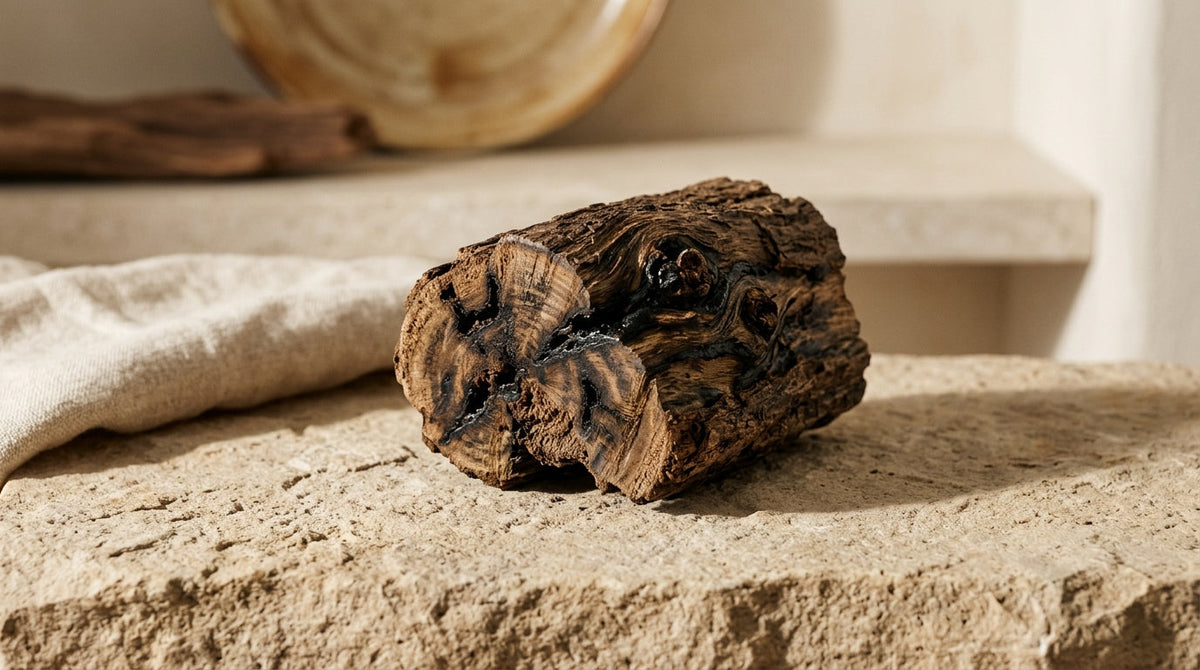
Agarwood is not found in just any tree of the Aquilaria genus. The tree must be wounded—by an insect, fungus, or fracture—and then react to this wound by secreting a dark, fragrant resin to protect itself. It is this resin, infused into the wood, that produces oud. Without a wound, there is no resin: the wood remains white and odorless.
In nature, this infection affects only a minority of trees, and its intensity varies greatly from one tree to another. This is why, since the 1990s, particularly in Thailand and Malaysia, producers have developed artificial inoculation techniques—drilling into the trunk and injecting fungi or stimulating solutions—to induce the resinification process in plantations. Even when inoculated, a tree takes several years to produce usable resin, and not all inoculated trees respond in the same way.
An extremely low distillation yield
Once the infected wood is harvested, it must be distilled with water to extract the essential oil, known as oud oil or dehn al oud. The yield of this distillation is among the lowest in all of perfumery: depending on the quality of the wood and the methods used, it takes between 20 and 70 kg of agarwood to obtain just 12 ml of pure oil, often resulting in a yield of less than 1%. For lower-quality woods, several hundred kilos may be required to achieve a comparable result.
The distillation process itself is lengthy: between several days and several weeks of water distillation, depending on the traditional methods used, particularly in Cambodia, India, or Laos. This production time ties up equipment and labor for a period that few other raw materials in perfumery require.

The tola, a unit inherited from historical trade
Unlike most raw materials in perfumery, which are sold by the gram or kilogram, oud is traditionally traded in tola, a unit of measure originating in the Indian subcontinent that is equivalent to approximately 11.66 grams. This unit dates back to the historical trade of oud between India, the Middle East, and Southeast Asia, where it was already used to weigh gold and precious spices. Even today, the price of oud oil is still expressed in price per tola in specialized markets in the Gulf and Asia, and this unit remains the standard for comparing different qualities.
A material regulated by CITES
The Aquilaria genus, the main source of agarwood, is listed in CITES Appendix II (Convention on International Trade in Endangered Species of Wild Fauna and Flora). It was first listed for Aquilaria malaccensis in 1995, then extended to all Aquilaria and Gyrinops genera during the thirteenth conference of the parties, held in October 2004, and came into force in January 2005. This listing does not ban trade, but requires export and import permits, issued to ensure that harvesting does not threaten the survival of wild tree populations.
In practice, every batch of agarwood or oud oil that crosses an international border must be accompanied by these documents. This traceability has administrative and logistical costs that are reflected in the final price, but it has also helped structure a market where legal, documented plantations are gradually replacing the uncontrolled exploitation of Southeast Asian wild forests.

Why prices vary so widely from one oud to another
A consumer comparing two bottles labeled "oud" may notice considerable price differences that do not appear to be related to volume. This is due to several combined factors: the origin of the wood (Cambodian and Indian woods have different reputations and availability), the age of the tree at the time of harvest, the extraction method (water distillation, supercritical CO2 extraction, or dilution in a solvent), and the actual proportion of natural oud oil in the final composition—many so-called "oud" perfumes actually use synthetic molecules that recreate part of its olfactory profile at a much lower cost.
Our selection
To compare different interpretations of oud without committing to a full bottle, perfume extracts allow you to test higher concentrations of the material, where oud oil is most influential in the composition. The oud perfumes collection brings together the catalog's references built around this material, from raw wood to more elaborate compositions. Our selection of the finest oud perfumes details eight, profile by profile.
Frequently asked questions
Is the most expensive oud always the best?
No. The price reflects scarcity and extraction yield, not necessarily olfactory preference. A renowned Cambodian wood may cost more than Indian wood without either being objectively superior to the other: the choice depends on the desired olfactory profile.
Does synthetic oud really exist?
Yes. Molecules such as those developed by major fragrance houses reproduce part of the woody and animalic facets of natural oud at a much lower cost. Many mainstream perfumes use these reconstructions exclusively.
Why do some ouds smell very different from one another?
Because the olfactory profile depends on the Aquilaria species, the harvesting region, the age of the infected wood, and the distillation method. Cambodian, Indian, and Laotian woods have different profiles, even when distilled using the same process.
Has the price of oud increased significantly in recent years?
Pressure on wild Aquilaria populations and growing demand from the Middle East and Asia have contributed to a continuous increase over several decades, partially offset by the development of inoculated tree plantations.
Do all oils sold as "oud" contain real agarwood?
No. Some compositions use only aromatic molecules that recreate the oud profile, without any trace of natural agarwood. The term "oud" on a product often refers to an olfactory family rather than a guarantee of raw material.
This documented scarcity is reflected in references that place agarwood at the center of their composition: Oud Suprême, built around a woody, leathery facet, or Oud Bakhoor, which works the material in its smoky, woody form close to traditional incense. Oud Aquilaria, meanwhile, refers directly to the botanical genus mentioned above, between woody and floral notes.
Key takeaways
The price of oud is explained by the combination of three verifiable facts: a rare natural infection that makes the raw material difficult to obtain in large quantities, a distillation yield that requires dozens of kilos of wood for a few grams of oil, and CITES regulations that structure and document the international trade of the material. To better understand what this material is and how it is used in perfumery, our article what is oud details its extraction and uses, and the page Oud brings together the entire dossier.
Sources: CITES (Convention on International Trade in Endangered Species of Wild Fauna and Flora), Fragrantica, Osmothèque, Robertet raw material publications.