
What is oud? The most expensive wood in perfumery
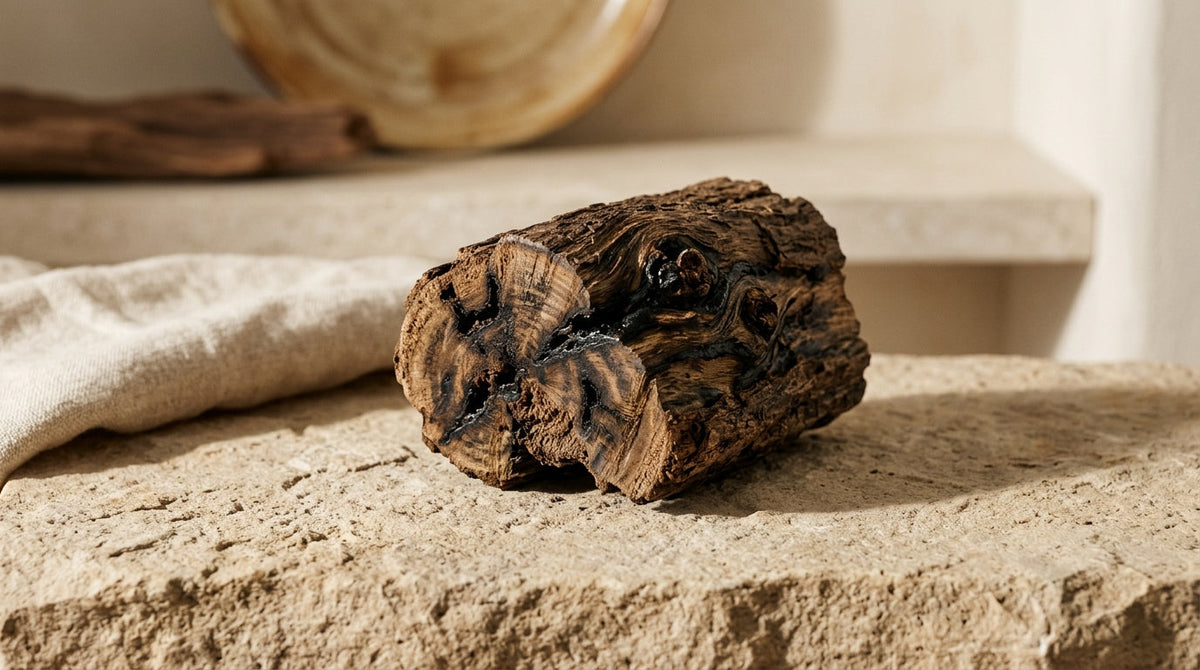
Oud is not a wood. It is a resin that certain trees in Southeast Asia produce to defend against an infected wound, which eventually permeates their wood until it turns black. Less than one in ten wild trees contains it, and you often have to fell it to find out.
That is where everything else comes from: the price, the rarity, the international protection, and the considerable gap between two bottles that nevertheless bear the same word on the label. Here is what you need to understand before buying your first oud perfume.
Oud is not a wood, it is a defense
The trees concerned belong to two genera in the Thymelaeaceae family: Aquilaria, which according to classifications counts from nineteen to thirty-one species, at least thirteen of which produce resin, and Gyrinops, about eight species. When healthy, these trees produce a pale, light, and odorless wood. Nothing worth anything.
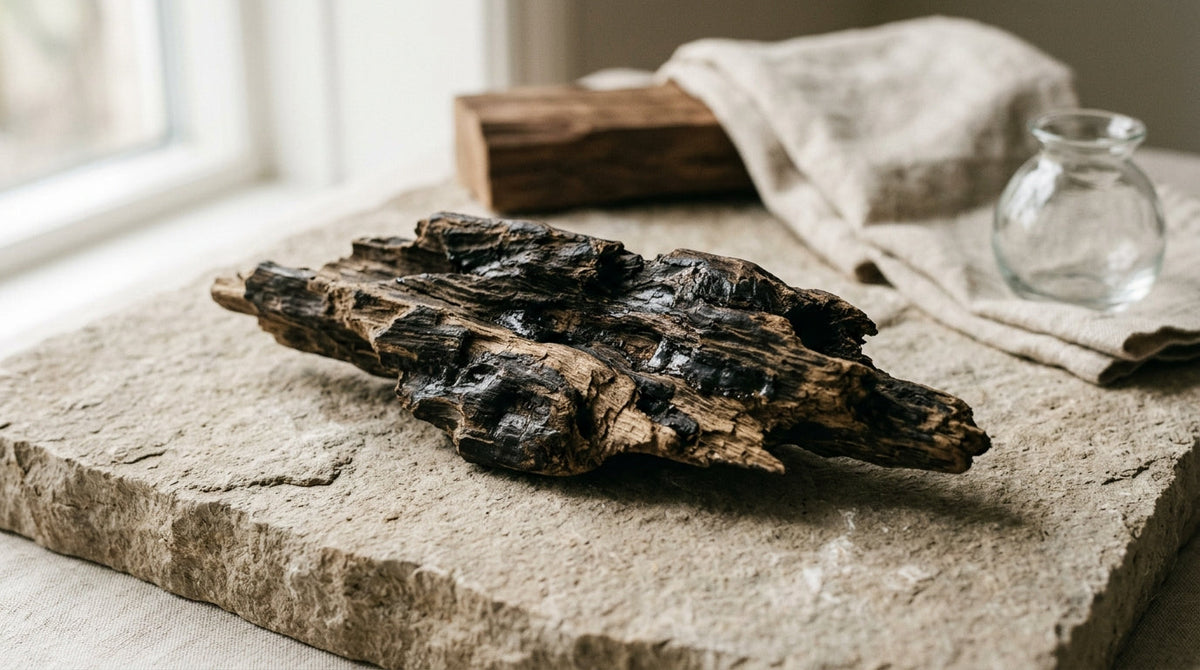
Everything changes when the tree is wounded and the cut becomes infected—most often by fungi carried by wood-boring insects. The tree responds by producing a resin laden with aromatic compounds, which hardens in place and gradually saturates the wood around the wound. That wood becomes dark, dense, and heavily scented. That is what is called agarwood, agarwood, or oud.

Less than one in ten trees, and twenty-five years of waiting
The reference report written for CITES is clear on this point: the proportion of trees containing agarwood in the wild is probably less than 10%. And nothing can be seen from the outside. A healthy tree and a resinous tree look alike, which explains most of the problem: to find out, you fell it.
Time works against exploitation as much as rarity. In nature, the formation of the resin takes twenty-five to thirty years. No supply chain can operate at this pace, hence the development of plantations and induced inoculation: the tree is deliberately wounded and microorganisms are introduced to trigger the reaction. A study published in 2017 on Aquilaria malaccensis, conducted in Assam, managed to induce the formation of the marker compound in three months, compared to six to twelve for previous work—the two most effective microorganisms were the bacterium Pantoea dispersa and the fungus Penicillium polonicum.
Inoculated plantation wood does not have the same qualities as thirty-year-old wild wood. But today it is the only way that does not deplete the resource.
What the resin actually contains
Chemically, agarwood is a complex mixture dominated by sesquiterpenes and chromones. The compound that serves as a marker of infection in scientific studies is agarospirol, accompanied by other indicators such as benzylic acetone.
This complexity explains one thing that every enthusiast eventually discovers: there is not one oud scent, but dozens. The tree species, the region, the age of the resin, the microorganism responsible for the infection, and the extraction method produce very different profiles. An Indian oud and a Cambodian oud have little in common to the nose.
A material under international protection
The pressure on wild populations has led to strict regulation. Aquilaria malaccensis was listed in CITES Appendix II in 1995, following an Indian proposal submitted the previous year. In 2005, during the thirteenth conference of the parties, the listing was extended to all species of the genera Aquilaria and Gyrinops. All parties and all derived products are controlled, with the exception of seeds, pollen, seedlings, fruits, leaves, and spent powder.
Aquilaria malaccensis is also classified as critically endangered on the IUCN Red List, 2018 assessment.
Appendix II is not a ban: it is a permit system. Trade remains legal, it is documented. This is also what makes the traceability of an oud as decisive as its scent.
What it is worth, in numbers
Between 2000 and 2020, declared exports amounted to approximately 19.7 million kilos for Aquilaria and 493,000 kilos for Gyrinops, which is nearly forty times less. The main exporting countries are Indonesia, Malaysia, and Thailand; the main importers, the United Arab Emirates, Saudi Arabia, Singapore, and Taiwan.
On the price side, the same report cites superior qualities reaching $100,000 per kilo, and agarwood oil around $40,500 per liter in 2021. These figures concern the raw material, not the perfumes that contain it—but they explain why a house that works with natural oud cannot offer the same prices as a house that works with a reconstruction.
In what forms you encounter it
Oud reaches you in three main forms.
- Burning chips. This is the oldest use: pieces of resinous wood placed on charcoal, alone or coated in perfumed oils. This is the principle of bakhoor.
- Pure oil, often called dehn al oud, obtained by distilling the wood after soaking. It is applied in very small quantities, without alcohol.
- The note in an alcoholic perfume, the only form under which most Western enthusiasts encounter oud. It is then associated with other materials that frame and soften it.

What does oud look like in a perfume
In the store, it is the material that provokes the most polarized reactions. Depending on the origin and dosage, it is recognized for its woody, leathery, smoky, sometimes frankly animalic facets, and in some ouds a sweetness that is almost honeyed or balsamic.
Compositions intended for the European market almost always frame it: rose and saffron to soften it, vanilla or labdanum to round it out, citrus to open it. This is what explains that the same word, on two bottles, sometimes covers two opposite experiences.
Our selection is gathered in the Oud Perfumes collection, and the essential of these creations is also found in the woody perfumes and the amber perfumes. To go from principles to bottles, our selection of the most beautiful oud perfumes in the catalog details eight references and their profiles.
Frequently asked questions
Is oud of animal origin?
No. It is an entirely plant-based material: a resin produced by a tree. The confusion comes from its animalic facets, which remind of leather or fur without coming from them.
Oud, sandalwood, cedarwood: are they the same family of notes?
No. They are three distinct materials. Sandalwood and cedar are naturally aromatic woods; oud is a resin formed in a wood that, without infection, has no scent.
Why do some "oud" perfumes not smell like oud?
Because they are built around a synthetic reconstruction, or a very low dosage of natural material framed by rose and saffron. This is not a deception in itself: it is a formula choice, which has its reasons and its supporters.
Is oud suitable for someone who is starting out?
Yes, provided you start with a composition where it is framed rather than a pure oil. A floral or fruity oud is a much better entry point than a raw oud.
Can you buy oud legally?
Yes. The listing in CITES Appendix II regulates trade through a permit system, it does not ban it.
To smell this variety without getting lost, it is best to compare the raw forms and the framed compositions: Luban Bakhoor and Oud Bakhoor remain close to the ancestral use of resinous wood burned on charcoal, while Oud Suprême illustrates the other path, that of an oud worked and framed in a woody and leathery elixir.
What to remember
Oud is a defense resin, not a wood. It is rarely formed, slowly, and invisibly from the outside—three facts that are enough to explain its price and its status as a protected species. It does not have one scent but a family of scents, whose range depends on the species, the origin, and the work of the perfumer.
There remains the question everyone asks next: why, concretely, does a bottle of natural oud cost what it costs? This is the subject of our article on the price of oud, and the complete dossier brings together all our resources on this material.
Sources: CITES, A review of the agarwood-producing genera Aquilaria and Gyrinops, CoP19 Inf. 12 · Frontiers in Microbiology, 2017, Aquilaria malaccensis, Assam · IUCN Red List, 2018 assessment.