
The Nose: What a Perfumer Really Does
A perfumer, or "nose," is a professional who creates fragrance formulas by blending raw materials in precise proportions, expressed in percentages or grams. This profession is not based on a mysterious gift but on an olfactory memory honed over many years and a technical practice akin to that of a chemist. This article details the training, the working palette, and the practical steps involved in creating a fragrance.
Extensive training before composing a fragrance
Becoming a perfumer generally requires attending a specialized school. In France, the ISIPCA (International Higher Institute of Perfume, Cosmetics and Food Aromatics), founded in Versailles in 1970 by Jean-Jacques Guerlain, trains perfumers through a curriculum combining organic chemistry, botany, IFRA regulations, and composition exercises. Other paths exist: some fragrance houses such as Givaudan or Firmenich recruit and train their own student perfumers in-house over several years before entrusting them with projects.
Training does not end with obtaining a diploma. A perfumer continues to enrich their olfactory memory throughout their career by smelling pure raw materials, pre-blended accords, and the creations of other noses every day. This repeated practice is what distinguishes a trained professional from an amateur, passionate as they may be.
The perfumer's palette: hundreds of memorized materials
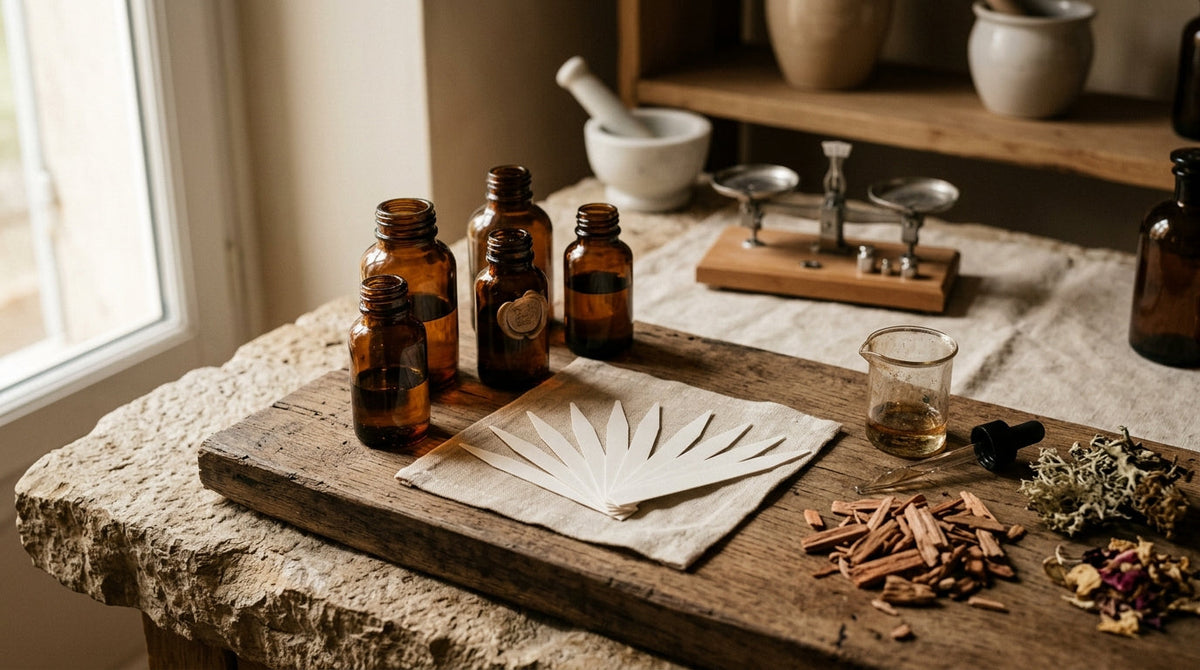
The perfumer's palette refers to the collection of raw materials they know well enough to use from memory, without having to smell them again before incorporating them into a formula. A professional perfumer generally works with a palette of several hundred materials: natural essences obtained through distillation or extraction, synthetic molecules such as musks or Iso E Super, and pre-blended bases created by raw material houses.
Each material is characterized by its top, heart, or base note, its potency, its longevity, and the way it behaves in a blend. An experienced nose knows that the same material can be radically transformed depending on the proportions and the other components of the formula: it is this deep knowledge, acquired through repetition, that distinguishes an experienced perfumer from a beginner.

From idea to formula: the steps of creating a composition
The creation of a fragrance rarely begins with a raw material: it most often starts with a brief written by a brand or niche house, describing an intention, a target olfactory family, or a theme. The perfumer then translates this brief into an initial formula, called a sample, which is submitted for evaluation.
This is followed by a process of back-and-forth revisions: each sample is modified, with a few tenths of a gram more or less of a material, one note removed, another substituted, until the desired balance is achieved. This process may require dozens, sometimes hundreds of versions before a formula is approved. The final formula specifies each material, its exact quantity, and the order of incorporation—a confidential technical document unique to each creation.
The role of the studio and evaluators
In major fragrance houses, the perfumer does not work alone: they are assisted by evaluators responsible for testing the fragrance's longevity on the skin, its sillage, and its stability over time. In niche perfumery, this role is often filled by the house's founder, who works in direct dialogue with the perfumer.

Salaried perfumer or independent perfumer
The majority of perfumers worldwide work for major fragrance houses—Givaudan, Firmenich, Symrise, IFF, Robertet, Mane—which provide formulas to the entire fragrance and cosmetics industry. These companies employ hundreds of perfumers across their international studios.
Niche perfumery operates differently: some houses hire independent perfumers who sign their creations with their names, while others continue to work with major fragrance houses without always disclosing the name of the nose. This diversity of practices explains why the perfumer's name is not always mentioned on a product page: the information depends on each house's communication policy, which can be checked on its official website.
Frequently asked questions
Do you need a diploma to become a perfumer?
Most professional perfumers have completed specialized training, such as that offered by ISIPCA in France, or an in-house program provided by a fragrance house. These programs combine chemistry, botany, and practical composition exercises over several years.
How long does it take to train your nose?
Memorizing a palette of several hundred materials requires several years of daily practice. A perfumer continues to refine their sense of smell and enrich their palette throughout their career.
Does a perfumer create a fragrance alone?
No: they generally work from a brief provided by a brand, in dialogue with evaluators or the house's founder, until a formula is approved by all parties.
What is the difference between a perfumer and a nose?
There is no technical difference: "nose" is the common term used in the profession to refer to a perfumer, in reference to their trained sense of smell.
How many materials does a perfumer truly know?
Their active working palette generally includes several hundred memorized raw materials, but an experienced perfumer can recognize several thousand different scents over the course of their career.
Behind every product page lies this invisible work of trials and adjustments mentioned above: whether it is an amber woody composition such as Santal de Paris, an oriental floral accord such as Jardins de Misfah, or a fruity powdery note such as Moroccan Iris, each formula is the result of a dialogue between a perfumer and a house, until the approved balance is achieved.
Key takeaways
The profession of perfumer is based on extensive training, an olfactory palette built material by material, and a methodical process of successive trials before a formula is approved. It is neither a gift nor a mystery, but a demanding technical practice akin to that of a precision artisan. To understand how this expertise is practically applied in the creation of a niche fragrance, our article on olfactory families helps to better understand the guidelines a nose uses every day.
Sources: official ISIPCA website (isipca.fr), official Givaudan website (givaudan.com), Osmothèque (osmotheque.fr).