
Alcohol-free perfume: oil, solid and extrait explained
An alcohol-free perfume replaces ethanol with an oil base — fractionated coconut oil, jojoba oil, sometimes a refined mineral oil — which dissolves the aromatic raw materials without volatilizing them as quickly. The result is not sprayed: it is dabbed on with a finger or onto the wrist, and it lasts on the skin according to a different logic from that of an eau de parfum. This format is not marginal: it dominates part of the Omani, Emirati and Saudi market, for reasons that are both practical and religious — ethyl alcohol raises questions in strict Muslim practice, and Gulf houses have for decades developed their own expertise in perfume oil.
Perfume oil, solid perfume, oily extrait: three different things
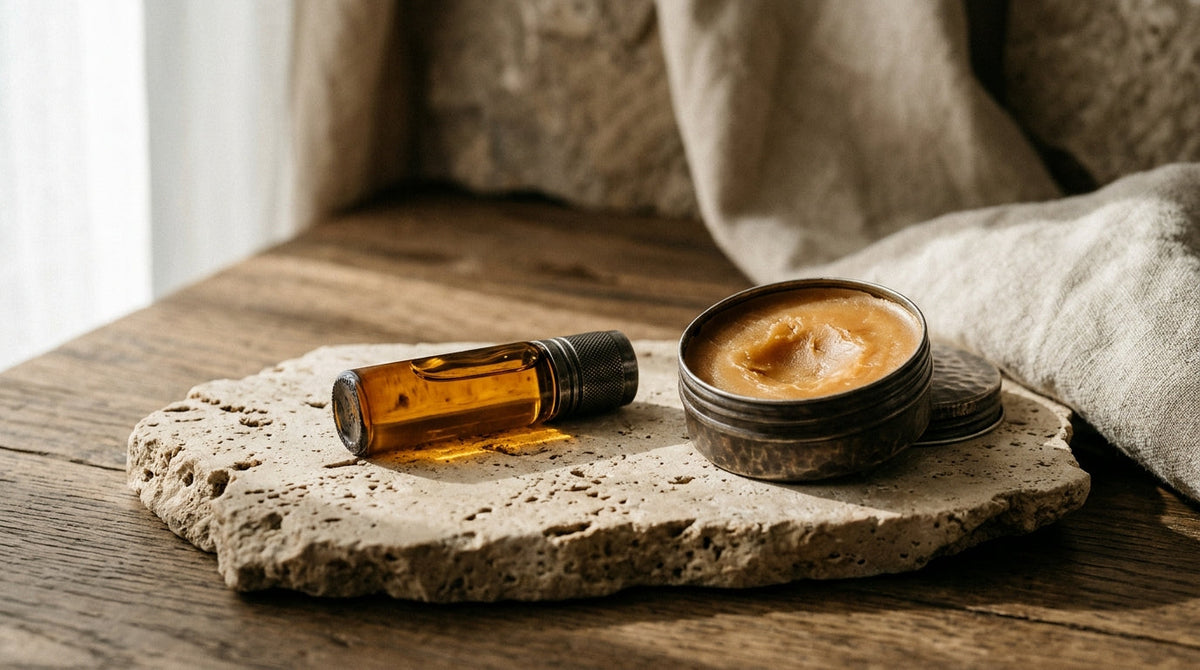
The term perfume oil refers to a dilution of aromatic concentrate in a carrier oil, generally between 15% and 30% raw materials — a concentration close to or higher than that of a classic alcohol-based extrait. It comes in a roll-on bottle or with a glass applicator rod.
Solid perfume is a set variant: the same perfume oil is mixed with wax — most often beeswax, sometimes candelilla wax for plant-based versions — then poured into a small container, often made of metal. The mixture stays solid at room temperature and melts slightly on contact with the skin.
Finally, the oily extrait de parfum is the term some houses use for a highly concentrated oil, designed as the equivalent of a classic alcohol-based extrait but without alcohol: it is the densest level of raw material relative to the carrier, before dilution.

Why the Gulf developed these formats
In Oman, the United Arab Emirates and Saudi Arabia, perfume is not sprayed on as you leave the house: it is applied to the wrist, behind the ears, on clothing, in a gesture close to a skincare ritual. This culture has produced pure oud oils — agarwood essence, distilled or solvent-extracted, without any alcohol dilution — sold by the gram, as well as complex compositions blending oud, rose and amber in an oil base. Bakhoor, the resin-infused wood burned to scent the air of a room, follows the same logic: perfuming without alcohol, through heat or contact, rather than through the evaporation of a spray.
In this tradition, pure oud-based perfume oil often comes in monolithic references, focused on a single material. In the catalog, this spirit can be found in compositions built around agarwood: Jelood, by Touch of Oud, pairs leather with a dense oud, in a construction close to what the pure oils of the Gulf offer, in an alcohol-based version.
What really changes on the skin
Without alcohol, the initial diffusion is more discreet: the ethanol in a classic eau de parfum projects the top-note molecules far from the body as it evaporates quickly, which creates the first sillage noticeable at a distance. An oil does not have this projection effect: the perfume stays close to the skin, noticeable mainly to those who come near. In return, longevity is often greater, sometimes twelve to twenty-four hours for a concentrated oud oil, because the molecules do not evaporate all at once with the solvent.
Body heat also plays a more direct role: a perfume oil warms up on contact with the skin and releases its notes gradually, whereas an alcohol-based extrait reveals its pyramid through the successive evaporation of the top, heart and base notes. This is one of the reasons why many Gulf oil formats are built around a single dominant material rather than a three-tier pyramid: the gradual release is enough to make the perfume evolve over time.

Solid perfume: use and limits
Solid perfume travels without any risk of leaking, goes through airport security with no liquid issue, and is applied with a finger — handy for a bag or a pocket. Its diffusion is the weakest of the three formats: the wax holds the molecules longer than oil alone, which further reduces the sillage noticeable at a distance, in favor of a very personal perfume, almost intimate in the literal sense of the word — noticeable only up close.
This discretion makes it a supplementary format rather than a main one: many use it alongside a spray, to revive a perfume during the day without taking out a glass bottle again.
Choosing according to what you are looking for
For a dense material and a close sillage, pure perfume oil suits lovers of woods and resins: an ambery, spicy composition such as Ambre Cristal, by Nectar Olfactif, illustrates in an alcohol-based version this register of concentrated amber that Gulf oils have long cultivated in alcohol-free form. For those looking for a very concentrated classic extrait without switching to the oil format, an extrait such as Imperial Harem, by Jousset Parfums, gives an idea of what lovers of dense formats look for: little volatile top, a heart and base delivered right away. The Extraits de Parfum collection brings together these high concentrations, and the Oud Perfumes collection lets you compare several interpretations of agarwood, whether alcohol-based or not.
FAQ
Does a perfume oil smell less strong than a spray?
It diffuses less far, because there is no alcohol to project the top-note molecules at a distance. On the skin, on the contrary, the concentration of raw materials is often higher than in an eau de parfum.
Is solid perfume suitable for all climates?
It melts more easily in high heat, which can make application less precise, but this does not affect its longevity once applied to the skin.
Can perfume oil be applied to clothing?
It is possible but risky on light-colored or delicate fabrics: the oil can leave a mark, unlike an alcohol-based spray, which evaporates without residue.
Do Gulf perfume oils contain natural oud?
Some do, in pure or near-pure concentration; others dose oud in a blend with other materials. The concentration level can be read on the label or asked about in store.
Does an oily extrait last longer than an alcohol-based extrait?
Often yes, because the absence of alcohol slows down the initial evaporation of the lightest molecules, which spreads their release over more hours.
Alcohol-free perfume is therefore not just a supplementary variant: it is another way of thinking about diffusion, built around contact with the skin rather than projection into the air. Understanding this logic helps you choose the right format for the intended use — wide sillage or discreet presence. To return to classic alcohol-based formats and their differences in concentration, the article on eau de toilette, eau de parfum, extrait usefully complements this read, as does the pillar page Understanding a Fragrance.
Sources: Fragrantica (product pages cited), Touch of Oud official website, Nectar Olfactif official website, Jousset Parfums official website.