
Spicy perfumes for winter: our Odorare selection
Winter changes the way a perfume behaves on the skin: the cold closes the pores, slows evaporation, and top notes fade faster than in summer. Spices, on the other hand, stand up well to this test: pepper, cardamom, saffron and clove have a molecular structure that sustains diffusion over time. That is why they appear so often in perfumes designed for the cold season. This selection presents eight references from the Odorare catalogue, chosen because the spice plays a real role in the composition, not merely a decorative role as a top note.
Why spice works particularly well in winter
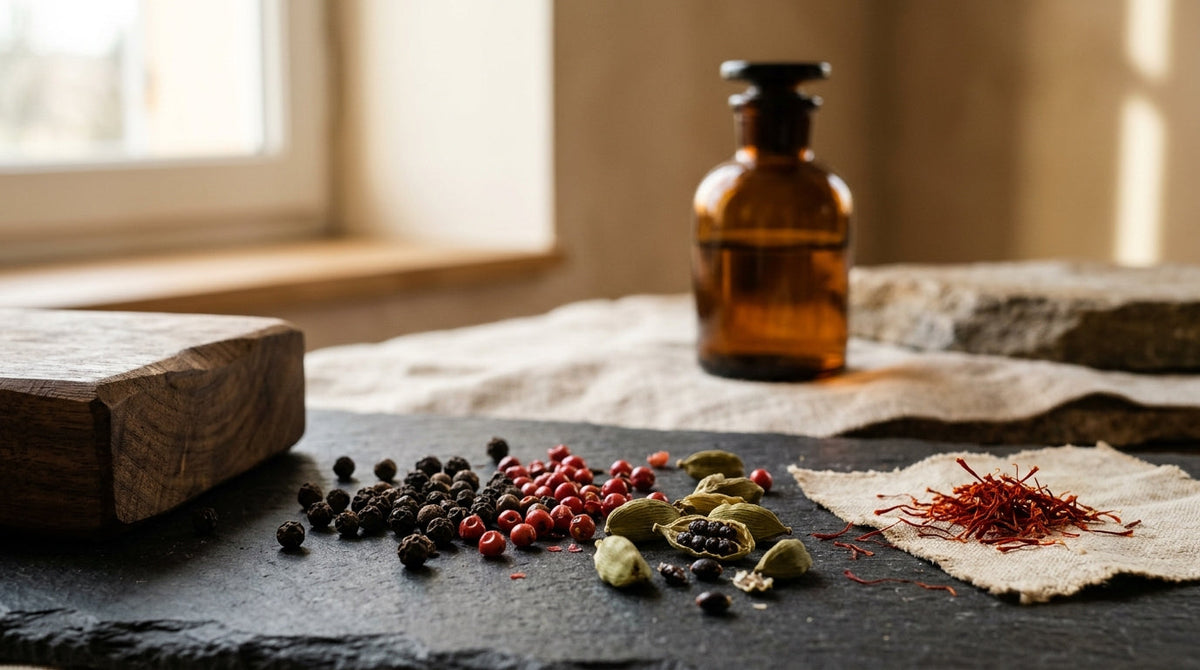
A spice in perfumery is not just a kitchen scent transposed into a bottle: it is a molecule or an extract with a precise behaviour on the skin. Black pepper, for example, owes its piquant facet to piperine, a molecule that evaporates slowly and keeps tingling the nostrils several hours after application. Cardamom brings an almost mentholated freshness at the top, which fades to make way for warmer facets, close to wood. Saffron, once dried and infused in alcohol, develops notes of leather and honey that do not exist in the raw spice used in cooking.
This olfactory richness explains why spices pair so well with winter materials: woods, resins, amber. They create a bridge between the freshness of a top note and the density of a warm base, which is exactly what we look for in winter — a perfume that warms without overwhelming.
Pepper, for a crisp and persistent spice
Black pepper and pink pepper are among the most widely used spicy notes in niche perfumery, because they give a composition relief without making it sweet. In 3 Poivres, the house UNIKA builds the entire composition around this material: three qualities of pepper layered from the greenest to the most roasted, for a spicy-woody sillage that holds steady for several hours. It is a useful reference for anyone who wants to understand what pepper can carry on its own, without any gourmand artifice around it.
In a more dressed-up register, Oriental Saffron by BOHOBOCO pairs pepper with a woody base and a touch of saffron: the spice stays crisp at the top, then gives way to a softer accord, typical of compositions designed for the colder months.
Cardamom, between freshness and warm spice
Cardamom holds a special place: it is one of the rare spices that brings freshness while remaining warm in the base. This dual facet makes it precious in winter perfumes, where one often seeks a balance between clarity and density. At NECTAR OLFACTIF, Safran Doré combines cardamom and saffron in a spicy-gourmand structure: cardamom opens the composition with clarity, before saffron takes over on a softer, almost honeyed base.
To explore this material in more depth, the collection dedicated to cardamom perfumes brings together other interpretations of the spice, useful for comparing styles.

Saffron, the spice that turns to leather and honey
Saffron deserves particular attention: dried and then infused, it loses its vegetal bitterness to develop notes close to leather, hay and honey. It is a rare material — the stigmas are harvested by hand from the Crocus sativus flower — that established itself in Gulf niche perfumery before reaching Europe. At RANIA J, T. Habanero uses saffron in an oriental-spicy accord that plays on the tension between the heat of chilli and the honeyed roundness of saffron, a balancing act that is fairly rare in this price range.
To understand in more detail how this material evolves from field to bottle, the article Saffron in perfumery: leather, honey and spice details the stages of transformation and the historical uses of the spice.
Spices and woods: the classic winter accord
On its own, a spice often ends up evaporating without a trace if it is not supported by a base material. That is why most winter spicy compositions rely on a wood or a resin. At KAJAL, Yasmina builds this balance between a spicy opening and a woody base that takes over after the first few minutes, for a sillage that grows denser over the hours rather than fading.
In a darker register, New Leather by NEW NOTES combines spices and leather in a structure reminiscent of a classic of the genre such as Opium by Yves Saint Laurent, a spicy oriental perfume widely known for having popularised this type of accord in the 1970s. In the same woody-spicy spirit, the catalogue also features 304 Ombre Pourpre by BON PARFUMEUR, a composition that pushes the smoky, resinous facet of the register further.

Clove and spices with a smoky facet
Less often used on its own, clove brings an almost medicinal, smoky facet that structures a spicy base. It is rarely found isolated in a composition, but it often takes part in broader accords combining woods, leather and resins. At LES BAINS GUERBOIS, 2015 Le Phénix illustrates this work well: a dense woody-spicy base, designed to last all winter without fading.
To explore the full spicy register of the catalogue — pepper, cardamom, saffron, clove, cinnamon — the Spicy Perfumes collection lets you compare styles from one house to another.
Pairing spice with amber for an even more enveloping perfume
For a winter perfume that favours warmth over clarity, the spice-amber pairing remains a safe bet. Amber, whether labdanum, benzoin or ambroxan, extends the longevity of a spicy composition by giving it extra density in the base. This approach was detailed in our selection of amber perfumes for autumn, which remains relevant for anyone looking for a transitional perfume between the two seasons. The Amber Perfumes collection broadens the search to this register.
How to choose your spicy perfume according to use
Three simple criteria help guide your choice. First, the clarity you are looking for: a pepper on its own, as in 3 Poivres, suits everyday wear, discreet but present. Next, the warmth of the base: a spice-wood composition like Yasmina or spice-leather like New Leather is better suited to evenings or very cold weather. Finally, the gourmand dimension: Safran Doré or T. Habanero suit those looking for a rounder, less austere spice.
Our selection at a glance
- 3 Poivres (UNIKA) — pure pepper, spicy-woody, everyday wear
- Safran Doré (NECTAR OLFACTIF) — cardamom and saffron, spicy-gourmand
- T. Habanero (RANIA J) — saffron and chilli, oriental-spicy
- Yasmina (KAJAL) — spices and woods, long-lasting
- New Leather (NEW NOTES) — spices and leather, dark register
- 304 Ombre Pourpre (BON PARFUMEUR) — smoky spicy-woody
- 2015 Le Phénix (LES BAINS GUERBOIS) — dense woody-spicy
- Oriental Saffron (BOHOBOCO) — pepper, saffron and woods
Frequently asked questions
What is the difference between a spicy perfume and an oriental perfume?
A spicy perfume emphasises one or more specific spices — pepper, cardamom, saffron — as the backbone of the composition. An oriental perfume refers to a broader family that often combines spices, resins and amber or vanilla notes in a dense, warm whole. Many winter spicy perfumes also belong to the oriental family; the two classifications frequently overlap.
Do spicy perfumes last longer in winter than in summer?
Yes, overall. The cold slows the evaporation of molecules, which particularly benefits spicy and woody notes, heavier than citrus or green notes. A spicy perfume that seems discreet in summer can turn out to be much more present and persistent as soon as temperatures drop.
Can you wear a spicy perfume during the day?
Yes, provided you choose a composition where the spice remains crisp rather than wrapped in an overly dense base. A perfume built around pepper alone, for example, is very well suited to daytime wear, while a spice-leather or spice-amber composition lends itself better to evening wear.
Does saffron really smell of saffron in perfumery?
Not directly. Once infused in alcohol, saffron loses its culinary facet and develops notes of leather, dried hay and honey. It is this transformation that makes it such a sought-after material in perfumery, very different from the way it is used in cooking.
Which spice should you choose for a first spicy perfume?
Pepper is often the easiest entry point: crisp and recognisable, it requires no particular getting used to. Cardamom is a good second step, before moving on to denser spices such as saffron or clove, which need a well-built base to reveal all their richness.
In summary
Spices are not mere top notes: they structure a perfume's longevity over several hours, which makes them natural allies for winter. From the dry pepper of 3 Poivres to the honeyed saffron of T. Habanero, each reference in this selection illustrates a different facet of the spicy register. To continue exploring our seasonal selections, the Odorare Selections hub brings together all our guides by material and by season.
Sources: Fragrantica (pages for BOHOBOCO Oriental Saffron, RANIA J T. Habanero, UNIKA 3 Poivres), Osmothèque (technical sheet for Opium by Yves Saint Laurent), Bon Parfumeur official website.