
Article: The spice route: how the Orient shaped perfume
The spice route: how the Orient shaped perfume
Before any perfumer in Grasse had composed anything at all, merchants had already been carrying resins over thousands of kilometres for more than a thousand years. Western perfumery was built on very specific trade routes, linking the south of the Arabian Peninsula, India and Southeast Asia to the ports of the Mediterranean. Understanding these routes means understanding why certain materials are still associated with luxury and with the Orient today.
The incense route, the first great olfactory trade axis
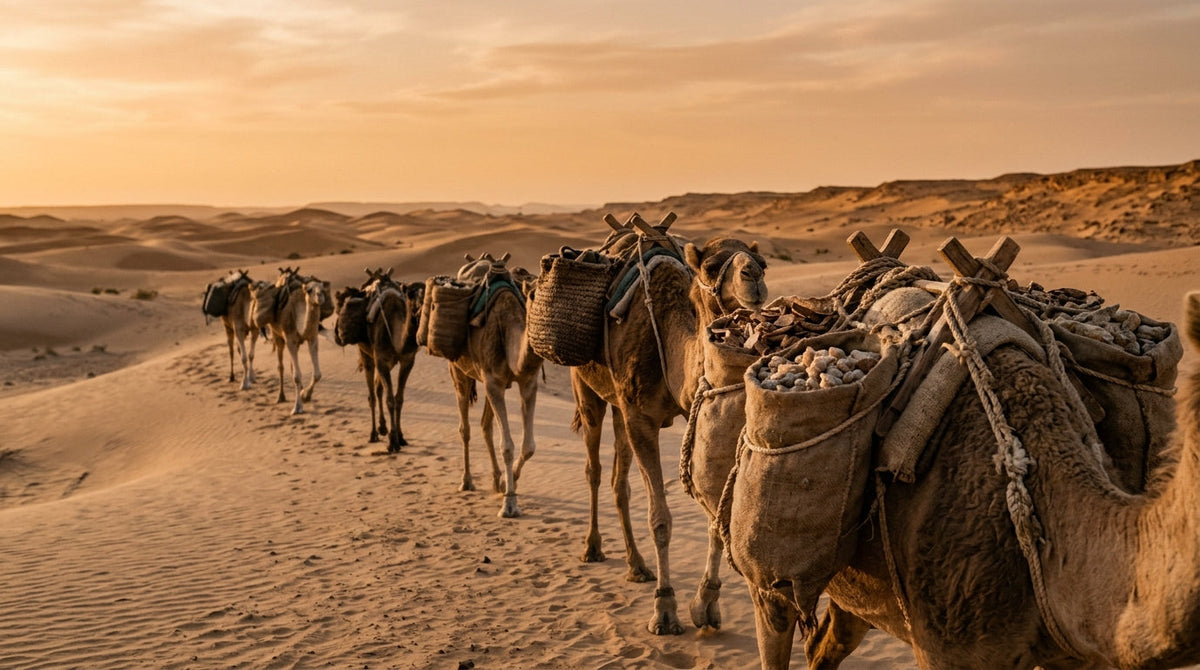
From the second millennium BCE, an overland route linked Dhofar, a region of present-day Oman that produces frankincense, to the cities of northern Arabia and then to the Mediterranean. This incense route crossed some 2,400 kilometres of desert, punctuated by caravanserais where dromedary caravans stopped to resupply and pay taxes. Relay cities such as Shabwa, Ma'rib and Petra prospered directly from this flow of goods, levying a toll on every load of frankincense and myrrh.
Frankincense (olibanum), a gum resin harvested by making incisions in the bark of Boswellia sacra, and myrrh, obtained in the same way from trees of the genus Commiphora, made up most of the cargo. These resins dried in the open air before being sorted by quality and then shipped to Egypt, Greece and Rome, where they went into the making of ointments and fumigations. To understand exactly how this resin is harvested and processed today, the article on frankincense (olibanum) details the incision process and the quality criteria of Omani Hojari.
The trading posts of the Red Sea and the Indian Ocean
Alongside the overland route, a maritime trade developed from the first century CE, driven by knowledge of the monsoon winds. Ships set out from the ports of the Red Sea, sailed along the southern coast of Arabia, then crossed directly to India thanks to the regular monsoons. This maritime shortcut considerably reduced journey times: what took months by land could be covered in a few weeks by ship.
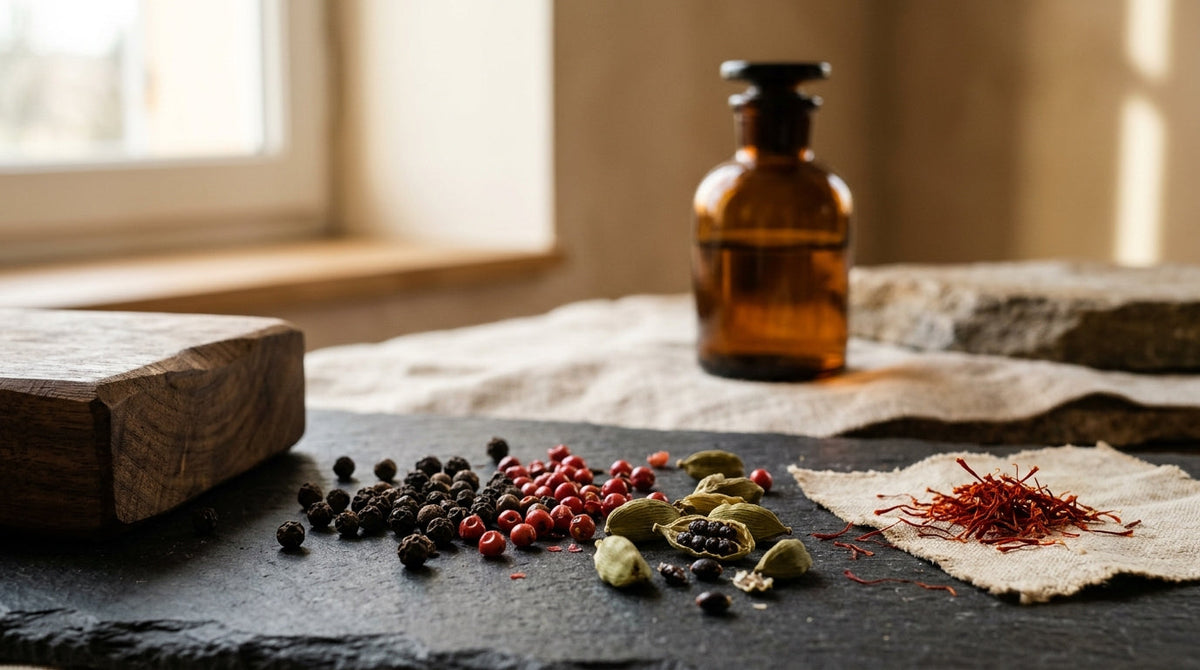
It was these sea routes that brought to the Mediterranean materials from far beyond Arabia: black pepper from Malabar, cinnamon from Ceylon, cardamom from the Indian coast. Ports such as Aden, Muscat and later Hormuz became compulsory transshipment points, where cargoes changed ships before continuing on to Egypt or Byzantium.

Alexandria, Venice, Marseille: the gateways to Europe
Once the resins and spices had reached Egypt, the port of Alexandria acted as the hub for the Mediterranean world. From the Middle Ages onwards, it was Venice that captured most of this flow: the city concluded trade agreements with the Mamluk sultanates of Egypt to obtain privileged access to the spices and resins of the Orient, which it then redistributed to the rest of Europe.
Marseille held a similar position on the French side, serving as a gateway for materials coming from the Levant. It was through this port that benzoin from Sumatra, styrax from Asia Minor and part of the musk from Central Asia passed, before reaching the workshops of perfumers and glove-makers in the south of France. This constant circulation of rare materials directly fuelled the rise of Grasse as the capital of perfume, where these imported ingredients were combined with local flower growing.
Materials that remain marked by their origin
This long trade explains why certain raw materials still evoke a specific elsewhere in today's perfumery. Oud, the wood of the Aquilaria tree infected by a fungus and harvested in Southeast Asia, today follows distribution channels inherited directly from these ancient routes, often passing through Gulf markets before reaching Europe. The extrait de parfum Trat, by Jouri Perfumes, is in fact named after a Thai province renowned for its agarwood, a direct reminder of this commercial geography.
Saffron follows a comparable logic: hand-harvested from crocus flowers, it long travelled from Iran and Kashmir to Mediterranean markets before entering Western composition. The eau de parfum Salalah, by Contes de Parfums, pays tribute in its very name to this region of Omani Dhofar, the historical starting point of the incense route mentioned above.

What the resin trade bequeathed to the vocabulary of Western perfume
A classic such as Shalimar by Guerlain, built on an oriental accord of amber and resins, owes its olfactory vocabulary directly to these centuries of exchange: the very idea of an “oriental perfume” as a Western olfactory family is a legacy of this trade, not a laboratory invention. In this resinous, ambery spirit, the catalogue offers the extrait de parfum Oud Elixir, by Nysos Parfums, which combines agarwood and resinous materials in a dense construction close to this oriental tradition.
The trade route also imposed certain composition codes: the layering of resins, spices and heavy woods, originally intended to mask odours and signal social status, became a structuring principle of so-called oriental perfumery. The extrait de parfum Watan Gold, by Anfas, illustrates this construction by layering a woody base with spicy accords, in direct continuity with these ancient compositions. The Oud Perfumes collection today brings together most of these olfactory legacies of the Asian trade, while the Incense collection groups the resins that are burned directly, without being turned into liquid perfume.
Frequently asked questions
Why is the “spice route” spoken of in the plural?
Because there was no single path but a network of overland and sea routes, linking different producing regions (Arabia, India, Southeast Asia) to different Mediterranean points of entry depending on the period and the political balance of power.
Are the incense route and the spice route the same thing?
No. The incense route specifically referred to the overland transport of frankincense and myrrh from southern Arabia. The spice route, which is broader, also encompasses the maritime trade in pepper, cinnamon and cardamom from India and Southeast Asia.
Why did Venice dominate this trade in the Middle Ages?
Thanks to its geographical position and to trade agreements negotiated directly with the sultanates of Egypt, which gave it privileged access to the cargoes arriving in Alexandria, before redistribution to the rest of Europe.
Do these trade routes still exist today?
The historical paths have disappeared, but the logic persists: oud from Southeast Asia still largely transits through Gulf markets before reaching Europe, a commercial circuit inherited from previous centuries.
Which present-day raw materials come directly from this heritage?
Omani frankincense, myrrh, Asian oud, saffron and certain resins such as benzoin and labdanum remain directly linked to these ancient trade routes between East and West.
What to remember
Western perfumery has never been self-sufficient: it was built on centuries of importing resins and spices, from Arabia to Southeast Asia, first by land and then by sea. These circuits shaped not only the materials used, but also the very idea of what a “precious” or “oriental” perfume is in the West. To continue this story on the side of today's producers of these same materials, Gulf perfumery shows how Oman, the Emirates and Arabia carry on this commercial and olfactory tradition today.
Sources: Osmothèque, FAO (reports on the gum resin trade), IFRA professional association, historical publications on ancient trade routes, Fragrantica.