
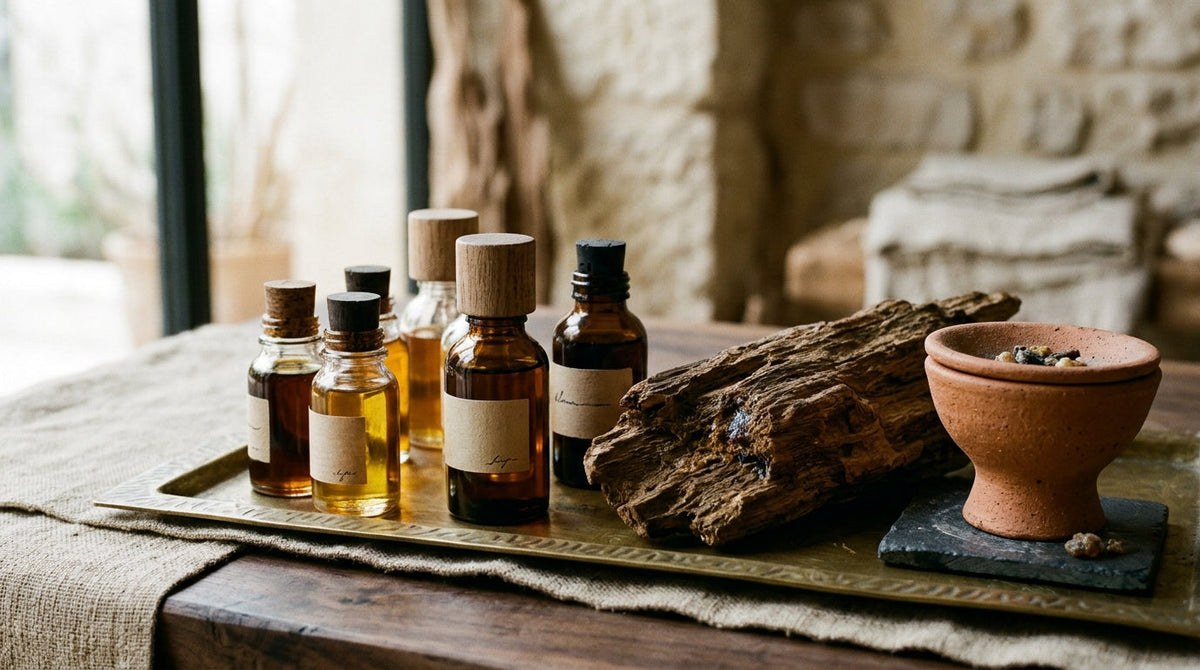
Perfume of the Gulf: Oman, Emirates, Arabia
In the West, a perfume is chosen, applied in the morning, and lasts the day on its own. In the Gulf, the logic is different: several textures are layered—a concentrated oil, an eau de parfum, a bakhoor smoke—to create a multi-layered trail. This alternative concept of niche oriental perfume comes from three countries with similar but distinct practices: Oman, the United Arab Emirates, and Saudi Arabia.
Oman: concentrated oil and oud as a local material
Oman has a long tradition of perfumed oils (dehn al oud, sandalwood oils, floral oils) applied directly to the skin without alcohol. The region is also home to one of the historical sources of olibanum incense, harvested by making incisions in the Boswellia sacra that grows in the country's southern Dhofar region. Oud, however, is not a local resource: it is imported, processed, and bottled by Omani houses that have made it their signature. This is the case with Oman Luxury, an Omani house in the catalog: its Zafar is a woody amber eau de parfum that perfectly illustrates this dense, concentrated approach, far removed from light trails. In a spicier vein, Khanjar, from the same house, combines spices and woods in a deliberately heavy structure—the opposite of a citrus perfume designed to fade away.

United Arab Emirates: Dubai, a hub for creation and trade
The Emirates, and Dubai in particular, play a different role: less as a source of raw materials and more as a hub where Asian oud, Indian essences, and composition expertise meet. Several Emirati houses create perfumes designed for a global market, with a distinctly woody-oriental identity. Spirit of Dubai, an Emirati house in the catalog, is a prime example: Oud is a woody chypre eau de parfum that encapsulates this approach. In a more floral vein, Ajyal, also by Spirit of Dubai, shows that Emirati perfumery is not limited to wood: fruity and floral notes also have their place, layered over denser bases.
Saudi Arabia and beyond: houses that treat perfume like clothing
Within this same Gulf region, other houses create compositions designed as layers to be added one on top of the other rather than as a single perfume. Anfas is a prime example in the catalog: Sa'adah is a woody floral extrait de parfum that plays on concentration—an extrait, by definition, contains a higher proportion of aromatic materials than a classic eau de parfum, which explains its long-lasting nature and use in small quantities. In a completely different vein, Rahaba, from the same house, combines vanilla and flowers in an extrait designed to last on fabric as well as on the skin—a common practice in this region, where perfume also soaks into clothing.

Layering: a method, not an accident
What sets Gulf perfumery apart is not just its palette of materials, but its method of application. A concentrated oil is first applied to the pulse points, then an eau de parfum is layered on top, and the clothing is passed over bakhoor smoke before wearing it. The result is not a single perfume but a multi-dimensional experience, with each layer revealing itself at a different time of day.
This layering logic also explains why oud remains the backbone of so many Gulf compositions: it is a base material capable of supporting several layers without fading. Origins vary greatly depending on the region where the infected wood originated—a topic we detail in our article on the origins of Cambodian, Indian, and Laotian oud, which explains why two Gulf ouds can smell so different depending on the wood originally used.
Compare without confusing: three countries, three accents
Oman focuses on concentrated oil and a local incense tradition; the Emirates function as a composition crossroads, where Asian oud meets more contemporary styles; houses from the wider peninsula work with extrait as a textile material, designed to last on fabric. These are not hierarchies but accents, comparable to the differences between two French houses working with the same material to achieve opposite results.
Our selection for discovering these three approaches
To concretely compare these practices, four references from the catalog are enough to grasp the full range: the woody amber eau de parfum Zafar from Oman, the woody chypre eau de parfum Oud from the Emirates, and the two Anfas extrait de parfums, Sa'adah and Rahaba, which illustrate the logic of the concentrated extrait designed to last. To explore the material that runs through all these houses, the Oud Perfumes collection brings together all the references in the catalog built around this wood. The Oman Luxury, Spirit of Dubai, Anfas, Touch of Oud, and Al Jazeera Perfumes collections each allow you to explore a Gulf house in its entirety.
Can these houses be compared to a Western classic?
A useful benchmark for situating these compositions is Tom Ford's Oud Wood, a widely known woody amber that popularized oud among a Western audience. In this woody-amber spirit, but with the concentration and density characteristic of the Gulf, the catalog offers Dejan by Oman Luxury, a denser woody amber eau de parfum that is closer to regional usage.
Why do these perfumes seem so concentrated?
Because many are offered as an extrait or oil, forms that contain a higher proportion of aromatic materials than a classic eau de toilette. This concentration is designed for regional use: applied in small quantities, the perfume lasts all day without reapplication.
Is bakhoor a perfume?
No: it is a smoke, not a liquid sprayed on the skin. It is used to infuse clothing, hair, and the interior of a room by burning it on charcoal or a warming plate, complementing a perfume worn on the skin.
Why do so many Emirati houses focus on oud?
Because Dubai has established itself as a trading hub for agarwood from Asia, where raw materials, composition expertise, and the international market meet, making it a natural home for houses working with this material.
Can a Gulf perfume be layered with a Western perfume?
Yes, it is even a common practice: a concentrated oil as a base, followed by a lighter eau de parfum on top, allows you to combine long-lasting wear with surface freshness.
Are these perfumes all very sweet or very woody?
No: while wood and amber largely dominate, certain houses, such as Spirit of Dubai with its floral-fruity compositions, show that the region is not limited to a single style.
Key takeaways
Gulf perfumery is not simply a richer variant of Western perfumery: it is a distinct method of use, where oil, eau de parfum, and bakhoor are layered rather than replacing one another. Oman, the Emirates, and Saudi Arabia each bring a distinct accent, from concentrated oil to the composition crossroads. To continue this exploration, our pillar page on niche perfumery places these houses within the broader landscape of independent niche.
Sources: official Oman Luxury, Spirit of Dubai, and Anfas websites; Fragrantica (cited product pages).